


“The priority is a return to calm,” said French President Emmanuel Macron, as authorities prepared security measures ahead of fresh protests this weekend.
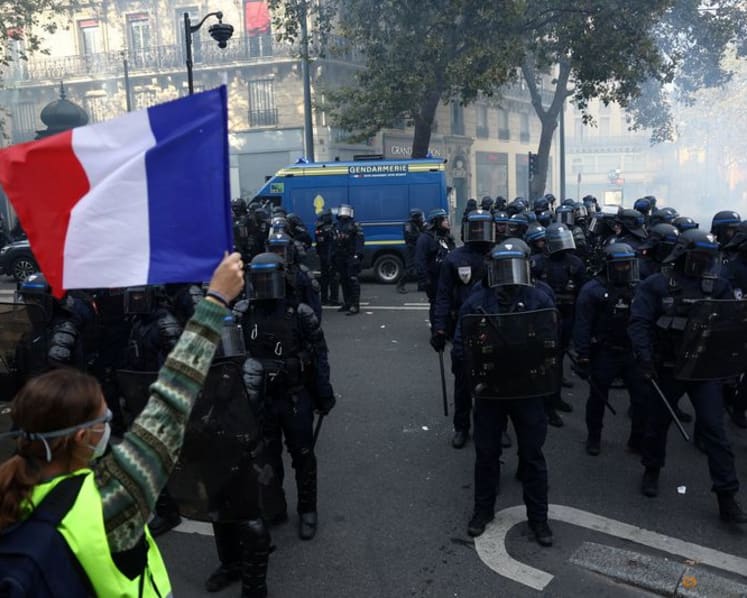
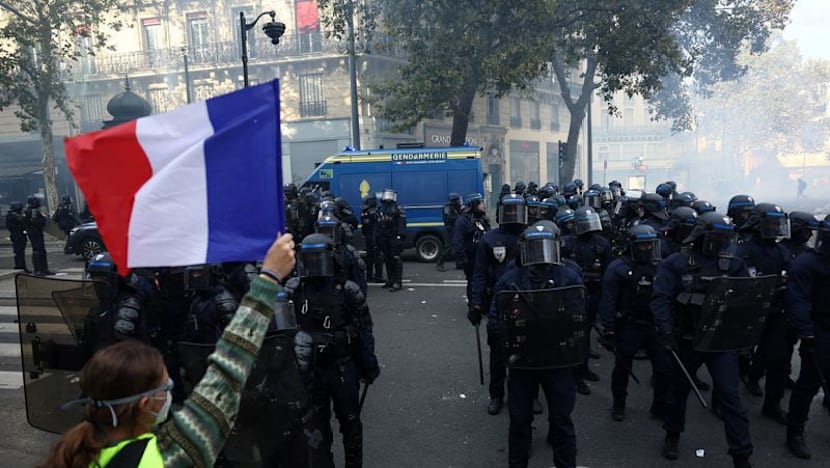
A protester wearing a yellow vest holds a French flag in front of French riot police amid clashes during a day of demonstrations against the cost of living and rising fuel prices in Paris, France, Oct 17, 2026. (Photo: REUTERS/Abdul Saboor)
PARIS: French authorities on Thursday (Oct 22) imposed bans or restrictions on fresh protests springing up in the wake of demonstrations last weekend that degenerated into the country’s worst street violence in years.
President Emmanuel Macron said after chairing a meeting of key ministers and intelligence officials that curfews and other security measures would be imposed, including bans on “groups without legitimacy” holding protests.
“The priority is a return to calm,” he said, adding that he would chair a defence council meeting of key ministers on Friday to decide “the next steps” for new nationwide demonstrations called for Saturday and afterwards.
The worst of the violence, Macron said, “was led by organised ultra-left groups aiming to bring down the republic”, that he accused of “sedition”.
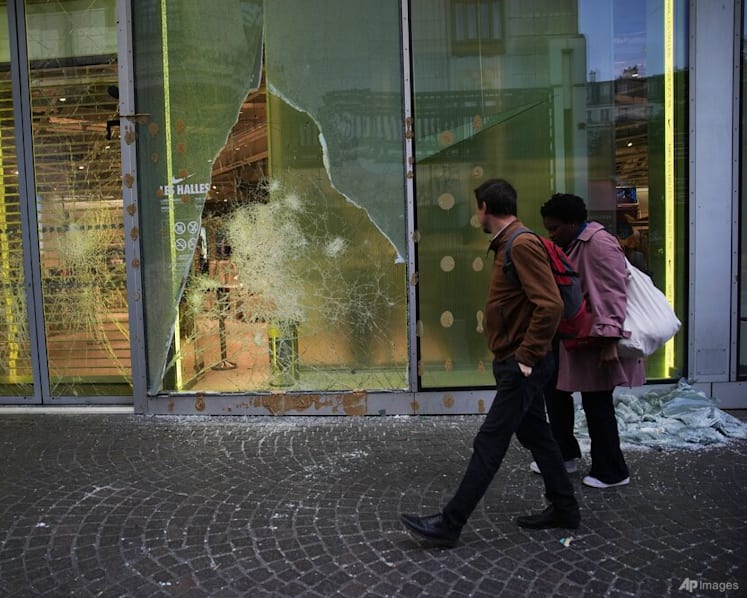
Officials are still reeling from the clashes, widespread looting and vandalism of public buildings that broke out on Oct 17, on the margins of mass demonstrations of more than half a million people against the surging cost of living.
Macron’s government has admitted police lost control, and candidates jockeying to succeed him in presidential elections in six months’ time argue that authorities are incapable or unwilling to calm the situation.
PROTESTS BANNED
A Paris protest Thursday organised by students – who had held four weeks of protests before the Oct 17 rallies – went ahead with hundreds attending after a police ban was overturned by an emergency court injunction.
“The authorities are trying to make a distinction between ‘good’ and ‘bad’ protesters,” a university student leader, Coppelia Moreau, said of that attempted ban and others being touted.
“What we are seeing is a government that doesn’t want any demonstrations at all. That goes against the right to demonstrate,” she told journalists.
Authorities on Thursday declared a ban on “all protests” in the southeastern city of Lyon on Saturday.
France’s third-biggest city suffered the looting of 200 to 300 shops last weekend and the torching of a tourist office in what its mayor described as hours of “chaos”.
Other cities, including Grenoble, Rouen, Le Havre and Toulon, issued bans on protests in their city centres.
In Paris, the city’s police said Thursday that the march planned for Saturday could be held in the east of the capital, starting at Bastille, but was banned from heading into the city centre, where shops and major public buildings are located.
The Yellow Vest movement organising the cost-of-living rallies along with unions said it did not agree with the order.
“We won’t sign off on it,” said Benjamin Ball, who runs an online map showing the planned locations of Saturday’s demonstrations.
Art Basel Paris, the capital’s biggest art fair, said it would shut this weekend, two days early, due to the protests.
France’s interior ministry said “20 per cent more” police would be deployed this coming Saturday than for last weekend.
DETENTIONS AND DIALOGUE
The French government has been projecting a firm response in the wake of last weekend’s violence, although Macron has said he would not go as far as to call a state of emergency.
Justice Minister Gerald Darmanin said Thursday that 217 people of 2,700 arrested during and since last weekend had been locked up, and that 1,000 more were being prosecuted.
On Thursday, a 66-year-old man was arrested over the arson last weekend of the 19th-century town hall of Limoges, prosecutors said. A man in his 30s had already been arrested Tuesday over the same crime.
Marine Le Pen, the far-right leader currently topping opinion polls for the April-May presidential elections, has accused Macron and his centrist government of being too soft and lacking authority.
Jean-Luc Melenchon, a far-left candidate criticised by the government for not strongly condemning the protest violence, blamed authorities’ “non-stop brutal repression” for the unrest.
Prime Minister Sebastien Lecornu on Thursday hosted a meeting of top officials from France’s main parties. While most sent their leaders, Le Pen’s National Rally was represented by a lower-ranking party official.
Lecornu was to follow that with a meeting with mayors, and on Monday he will meet student groups, unions and the employer federation.