


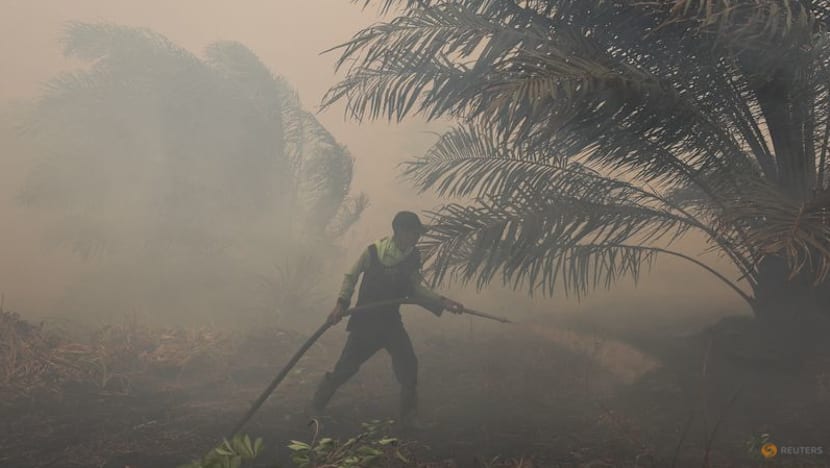
SINGAPORE: Palm oil cultivation company TSH Resources said on Thursday (Oct 22) that 274 hotspots detected within its estate between January and Oct 21 were in “community enclave areas” outside its operational areas.
The company was responding to queries from the Singapore Exchange (SGX) about whether its operations had contributed to the recent haze in Southeast Asia.
In a bourse filing, TSH Resources said no fire was detected within its planted or operational areas between January and Oct 21.
There was also no report or claim of fires started by its employees, it added.
“During the period, 274 hotspots were detected within the group’s estate boundaries and were all in community enclave areas, outside the group’s operational areas,” said TSH Resources.
The company said its field teams responded to and extinguished the fires, and lodged police reports for the incidents.
It also disclosed that a fire broke out on Aug 17 within the Hak Guna Usaha area of its subsidiary, PT Bulungan Citra Agro Persada (BCAP).
“The fire originated from a community enclave area outside BCAP’s operational area. BCAP extinguished the fire on the same day, lodged a police report and continues to cooperate with the relevant authorities,” TSH Resources said.
The company, which operates oil palm plantations and mills in Malaysia and Indonesia, maintained that its operations and activities within its Indonesian concessions had not contributed to the recent haze.
Senior Minister K Shanmugam had warned this week that Singapore would use every legal, regulatory and economic lever at its disposal against companies responsible for the haze.
The country has been facing stretches of unhealthy air quality due to the haze since Sep 4. At least one region in Singapore had unhealthy air quality from Oct 5 until Thursday afternoon.
Mr Shanmugam said that the SGX had asked questions of seven agri-companies listed in Singapore.
Besides TSH Resources, the other companies are Golden Agri-Resources, Bumitama Agri, First Resources, Wilmar International, Kencana Agri and Indofood Agri.
Kencana Agri said in response last week that Indonesian authorities have launched a preliminary inquiry into a fire incident at its subsidiary.
First Resources said on Tuesday that it welcomes on-the-ground inspections by the authorities as well as documentary and technical reviews, adding that it fully supports a “thorough, evidence-based examination of facts” into the ongoing haze situation.
COMPANY SAYS OPERATIONS DID NOT CONTRIBUTE TO HAZE
According to its SGX profile page, TSH Resources has oil palm plantations and palm oil mill in Sabah, Malaysia, as well as Kalimantan and Sumatera in Indonesia.
Among SGX’s questions were whether the company’s operations had contributed to the haze and whether it had received any allegations or enquiries about the recent fires in Indonesia or the haze.
TSH Resources said it had not been named or issued any notices by environmental agencies in connection with the recent transboundary haze.
It also shared that it received an enquiry from its customer, Apical Group, on Sep 1 about hotspots in PT Farinda Bersaudara, one of its subsidiaries.
PT Farinda Bersaudara was acquired by TSH Resources in 2008, according to the latter’s website.
The company said it had clarified that the hotspots occurred within community enclaves outside its operational area.
“Apical was satisfied with our clarification,” it added.
TSH Resources did not receive any other official enquiries and there were no media highlights about the company as of Oct 15, it said.
MEASURES IN PLACE
TSH Resources said it enforces a zero-burning policy across its operations, including land preparation, new planting and replanting.
The policy also extends to its contractors and suppliers, it added.
The company said it has fire prevention and emergency response measures in place, including regular ground patrols, trained firefighting teams and satellite monitoring.
“TSH’s in-house LiTUP system integrates multiple satellite data sources to monitor hotspots within concession boundaries and a 2km-buffer zone, providing updates approximately every three hours to support early detection and timely response,” it added.
The company said it also maintains its firefighting infrastructure, equipment and trained squads in accordance with legal standards in Indonesia.
Its Indonesian estates are certified under the Indonesian Sustainable Palm Oil scheme, which is subject to regular third-party audits.
The company said it had put in place the necessary measures to prevent, monitor and respond to fires, and did not consider further disclosure necessary as there had been no incident with a material impact on the group.