
Asia
Residents in Bengaluru’s Electronic City say nearby data centres are adding to pressure on local water supplies, while farmers outside the city oppose plans to acquire land for a township that would include AI-related industries.

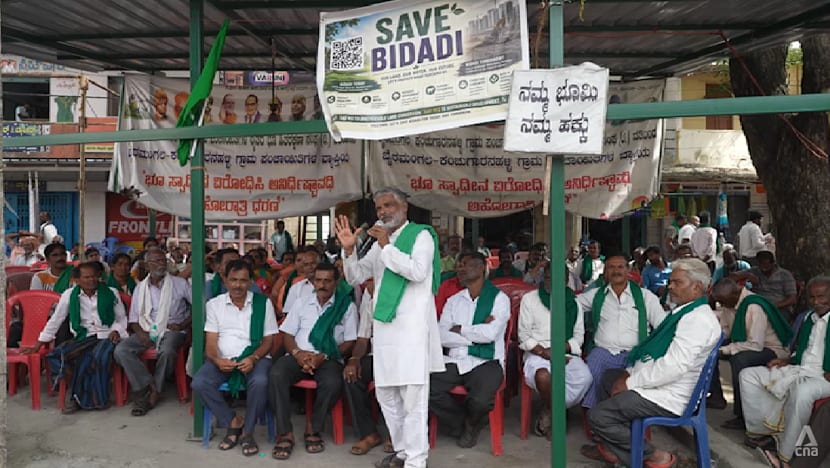
Farmers protest plans to acquire agricultural land for a proposed township near Bengaluru that would include AI-related industries. (Image: CNA)
New: You can now listen to articles. 
This audio is generated by an AI tool.

28 Oct 2026 03:32PM
BENGALURU: The southern Indian state of Karnataka is expanding its artificial intelligence infrastructure, raising concerns over the water and land needed to support the industry.
The state’s technology hub Bengaluru currently has 31 operational data centres, with more in the pipeline.
Meanwhile, plans to acquire land for a township outside Bengaluru that would include AI-related industries have met resistance from farmers who fear losing their livelihoods.
WATER SUPPLY CONCERNS
In Bengaluru’s Electronic City, a major technology and industrial area, IT executive Pranay Dubey lives in a residential complex with 264 flats.
According to a citizens’ group run by him, nearly 150 housing estates in the area rely on private water tankers because they lack connections to the city’s piped water supply.
The group believes nearby data centres, which can use large amounts of water to cool computing equipment, are worsening the situation.

“Water scarcity is one of the biggest challenges that we have … I think (data centres) are in fact multiplying the impact of water scarcity on the residents,” Dubey told CNA.
As AI becomes part of everyday life in Bengaluru, the Karnataka government has acknowledged the resource demands of data centres and is exploring ways to make them more sustainable.
Karnataka Home Minister Priyank Kharge, who also oversees the information technology and biotechnology portfolios, cited the use of treated wastewater, liquid cooling technology and greater reliance on renewable energy as possible measures.
“We want to see how we can make it greener, better, more sustainable,” he said.
FARMERS OPPOSE LAND ACQUISITION
Beyond Bengaluru, Karnataka’s plans to expand its AI ecosystem have also raised concerns over agricultural land.
The state government’s proposed Greater Bengaluru Integrated Township, near Bidadi, southwest of Bengaluru, includes plans to set aside more than 800ha for AI-related and ancillary industries.
Hundreds of farmers from several villages have been protesting plans to acquire land for the township for more than 18 months, saying the development threatens fertile farmland used to grow multiple crops.
Despite the resistance, the government issued a final notification in June to acquire about 210ha across three villages in the first phase of the project.
Environmentalist Lokesh BS said the area supports crops including betel nuts, coconuts and bananas, as well as sericulture, or silkworm farming.

Among those opposing the project is 45-year-old Neela, a mother of three whose family owns about 4ha of farmland.
She said the land has been passed down through generations, with the income from silk farming and betel nut cultivation helping to pay for her children’s education.
“The land is owned by our ancestors. They are making a township here and where else can we go now?” she said.
“We don’t want to give it to them. (Even with) the money they would give, we don’t want luxury cars or gold to live our lives. We are happy with what we have.”
BALANCE BETWEEN AGRICULTURE AND INDUSTRY
A month after issuing the land acquisition notification, the Karnataka government assured farmers that their land would not be taken by force.
It has also appointed a committee to review the township project and consider differing public views amid the opposition.
Kharge said industrial development remains important to Karnataka’s future.
“We are an agrarian economy and it’s always good to be that. But at the same time, there needs to be a healthy balance of industrialisation,” he said.
“In this era of rapid change, the last thing that you want to do is be left behind as a nation.”