
Commentary
Now that voters know the extent of the government’s failure to manage disaster mitigation efforts, the question is whether President Ferdinand Marcos Jr can turn it around, says Karishma Vaswani for Bloomberg Opinion.
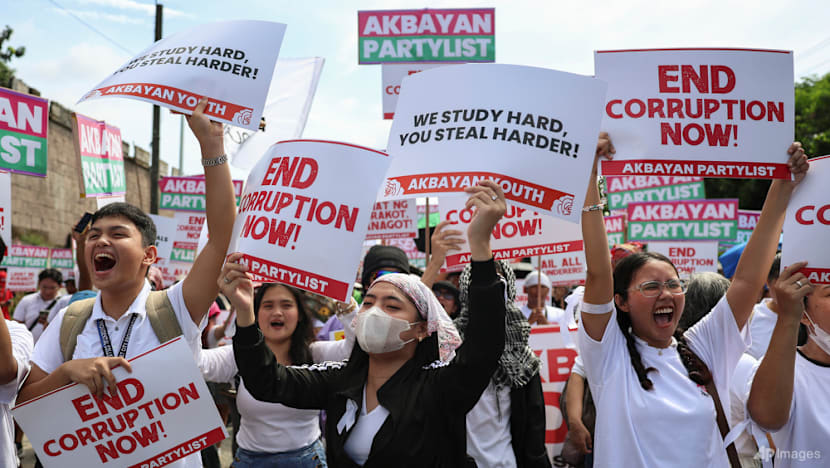
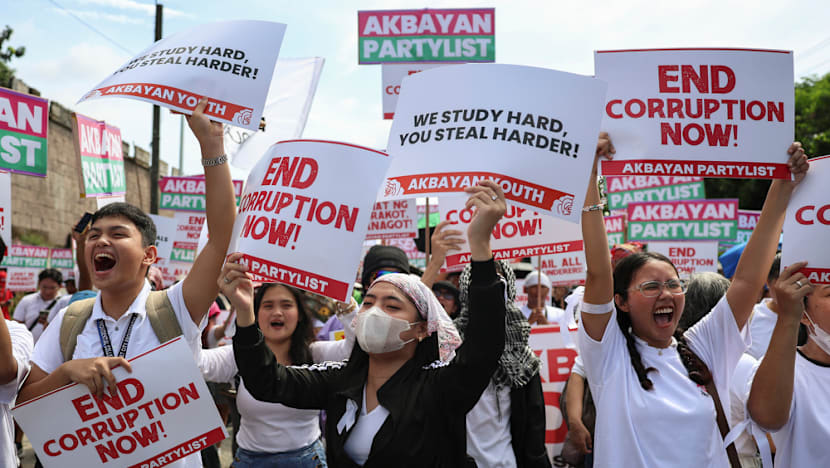
Protesters carry signs as they gather during a rally against government corruption at the EDSA People Power Monument in suburban Mandaluyong, east of Manila, Philippines, Sep 21, 2025. (AP Photo/Basilio Sepe)
SINGAPORE: The Philippines is one of the most graft-riddled countries in the world, routinely scoring toward the bottom of global corruption indices, alongside the likes of Sierra Leone and Angola. But even by its own troubled standards, the past few months have exposed how deep the rot goes.
The archipelago is in the grip of a scandal involving government ministers, senators, members of Congress and wealthy businesspeople. Two presidents, including the current leader’s father, were toppled by public uprisings over misrule. Will President Ferdinand Marcos Jr be next?
Earlier this month, hundreds of thousands of Filipinos packed Manila’s Rizal Park, demanding accountability for billions in missing flood-control funds. The movement is gaining strength: There were similar protests in September and more are planned this coming Sunday (Nov 30).
Marcos Jr was elected in 2022 on the back of high public expectations. But that goodwill is swiftly fading as Filipinos learn that many projects touted during his administration were defective, or worse – never built.
For a country battered by flooding and about 20 typhoons a year, the stakes couldn’t be higher. Now that voters know the extent of the government’s failure to properly manage disaster mitigation efforts, the question is: Can Marcos Jr turn this around?
SYSTEMIC MISMANAGEMENT
Protestors are demanding the arrest of those implicated in the graft and the return of stolen public money. Government officials say that over the past decade, losses due to corruption exceed a trillion pesos (US$17 billion). Authorities have detained several suspects and more are being pursued.
The president has pledged to jail those responsible by Christmas to contain the crisis that’s rapidly engulfing his administration – he’s already lost two ministers over corruption allegations (that they deny).
Each new case that comes to light shows how systemic the mismanagement is. “To have a government that makes dams that will break, or flood dykes that are substandard – or simply not build them – it feels like a deep betrayal when your country is so vulnerable,” Priyanka Kishore, founder and principal economist at Asia Decoded told me.
Investor confidence has been rattled. The peso has weakened, and the scandal has hit the economy, with GDP slowing to 4 per cent in the third quarter, the weakest pace since 2021. Consumer confidence has taken a hit, with household spending declining to a four-year low.
There are other reasons to be concerned. Last week, Alice Guo, a former mayor of Bamban, an agricultural town of about 78,000 people, was convicted and sentenced to life in prison for human trafficking over her role in setting up a scam centre. The case has highlighted how dysfunctional governance has become.
Some officials have alleged Guo might be a Chinese national who assumed a Filipino name to qualify for office, while others have suggested she could be a spy. Bamban lies near a Philippine military base that has hosted US forces, adding a sensitive strategic dimension in a country that is a key American ally.
Washington and Manila’s regional partners will be following the fallout with growing unease. It’s difficult to rely on a government to fully participate in an alliance to counter China when it’s fighting so many fires at home.
RISKS TO MARCOS JR
Marcos Jr is trying to reassure citizens that he is in charge, but risks to his credibility are growing. He first mentioned the graft scandal during his annual State of the Nation address to Congress in July, and promised to put a stop to the corruption.
This is a far cry from the image he projected during his 2022 election campaign. I was struck back then by how much he leaned on nostalgia to evoke the myth of perceived prosperity during his father’s authoritarian era. Many young voters, with little memory of martial law, bought into it. But surveys show sentiment is shifting.
He must act quickly if he’s serious about restoring trust. Fast-tracking cases and bringing more culprits to justice would go a long way toward assuaging public rage. The creation of a new anti-graft body must have teeth to go after offenders, otherwise it will remain a vanity project.
There are well-managed measures elsewhere in Asia. In Vietnam’s Mekong Delta, often beset with flooding, local communities are engaged to monitor projects to ensure transparency. Japan, a case study in effective disaster management, has built vast underground flood tunnels beneath Tokyo that are backed by strict audits and oversight.
The Philippines won’t be able to replicate those systems overnight. But building one that citizens can trust is essential. History has shown their patience will run out. This president shouldn’t wait for the past to repeat itself.
Comments are closed.