
China’s favouring of small and cheap models such as DeepSeek could prove to be the better bet, says John Thornhill for Financial Times.
Qwen and Alibaba logos are seen in this illustration taken Jan 29, 2025. REUTERS/Dado Ruvic/Illustration/File Photo
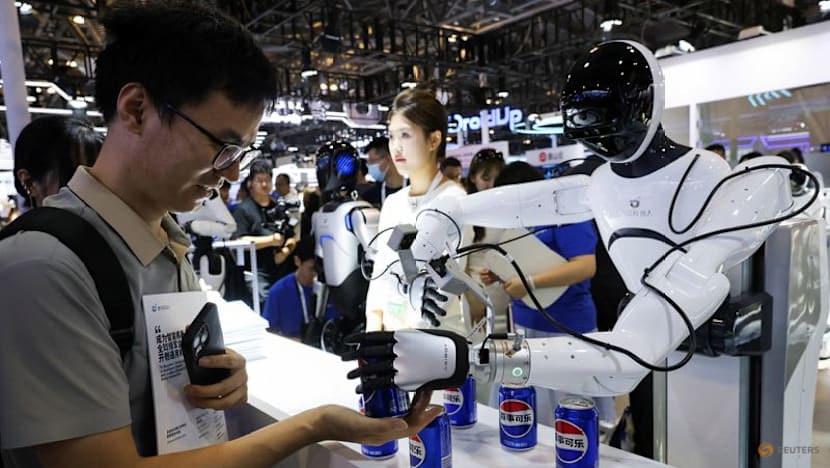
LONDON: Surrounded by kick-boxing, piano-playing humanoid robots at a high-tech fair in Shenzhen last month, some tech influencers were asking: Can the West catch up with China?
That question would have sounded absurd two decades ago, but it is anything but today. This week, the Australian Strategic Policy Institute published its latest critical technology tracker, covering high-impact global research in 74 areas. It found that China now leads in 66 of those technologies, in fields as varied as computer vision, quantum sensors and nuclear energy, with the US ahead in the other eight.
ASPI’s researchers highlighted a familiar story across many technologies. An early and overwhelming US lead in research output in the first decade of this century has been surpassed by China’s persistent long-term investment in fundamental research.
In 2005, China accounted for just 6 per cent of the world’s most highly cited research papers but that share had risen to 48 per cent this year. The comparable proportion of US publications fell from 43 per cent to 9 per cent. At a time when the US is defunding many federal science programmes, China is doing the opposite by “building the whole technology ecosystem”, says Jenny Wong-Leung, one of the report’s authors.
ASPI’s findings accord with Nature’s latest ranking of research institutions, tracking articles across 145 science journals. In terms of research output, nine of the world’s top 10 research institutions are Chinese with only Harvard University in the top tier. China is now mass manufacturing research; it truly has become a scientific superpower.
THE AI RACE
Published research, though, does not automatically translate into technological capability. Moreover, the location of research expertise does not always map with successful commercialisation of technology – as a long line of frustrated British scientists can attest.
However, a separate report from the Special Competitive Studies Project in the US earlier this year also highlighted the striking progress that China has made in adopting many frontier technologies.
According to the SCSP’s staff assessment, the US is still leading in semiconductors, synthetic biology and quantum computing while China dominates in advanced batteries, 5G and commercial drones. But the most contested, and arguably most consequential, area is artificial intelligence.
President Donald Trump has said that the US will do “whatever it takes” to lead the world in AI. And the big US tech companies, including OpenAI, Alphabet, Microsoft, Meta and Amazon, are making colossal investments to fulfil that ambition. OpenAI alone is planning to invest US$400 billion over the next few years to build out its Stargate data centres across the US.
Last month, the Trump administration launched the Genesis Mission to boost the private AI sector by sharing the public data sets and computing resources of the country’s 17 national laboratories.
“We’re essentially pitting our private capitalists against this nation state of China. The stakeholders here have two very different sets of resources, attributes, strengths and weaknesses,” says David Lin, a senior adviser to the SCSP.
DIFFERENT AI MODELS
But the US and China are also adopting very different approaches to adopting AI. The big US companies mostly favour massive, proprietary, “closed-weights” models, such as ChatGPT and Gemini, which may be best suited to achieving generalisable intelligence.
By contrast, Chinese AI companies favour smaller, cheaper (and arguably less safe) “open-weights” models, such as DeepSeek and Alibaba’s Qwen, that can be more readily adapted by developers.
In part, China is making a virtue of necessity because US export restrictions have denied it access to the state-of-the-art silicon chips needed to build the most powerful foundation models. But it also reflects China’s priority in rapidly diffusing the technology.
Michael Power, the former global strategist of the investment firm Ninety One, reckons the US is making a “catastrophic strategic error” in betting so heavily on giant closed AI models.
“China’s model is turning out to be far more effective in terms of usable compute in the real world,” Power tells me, especially considering the country’s lower energy costs. Even Sam Altman, OpenAI’s chief executive, has expressed his personal concern that “we have been on the wrong side of history here”.
A recent study by MIT and Hugging Face found that Chinese open models have now overtaken comparable US models in terms of global adoption. Many US companies, including Airbnb, have become fans of the “fast and cheap” Qwen. In this critical area too the question arises: Can the West catch up with China?
Source: Financial Times/el