


NEWYou can now listen to Fox News articles!
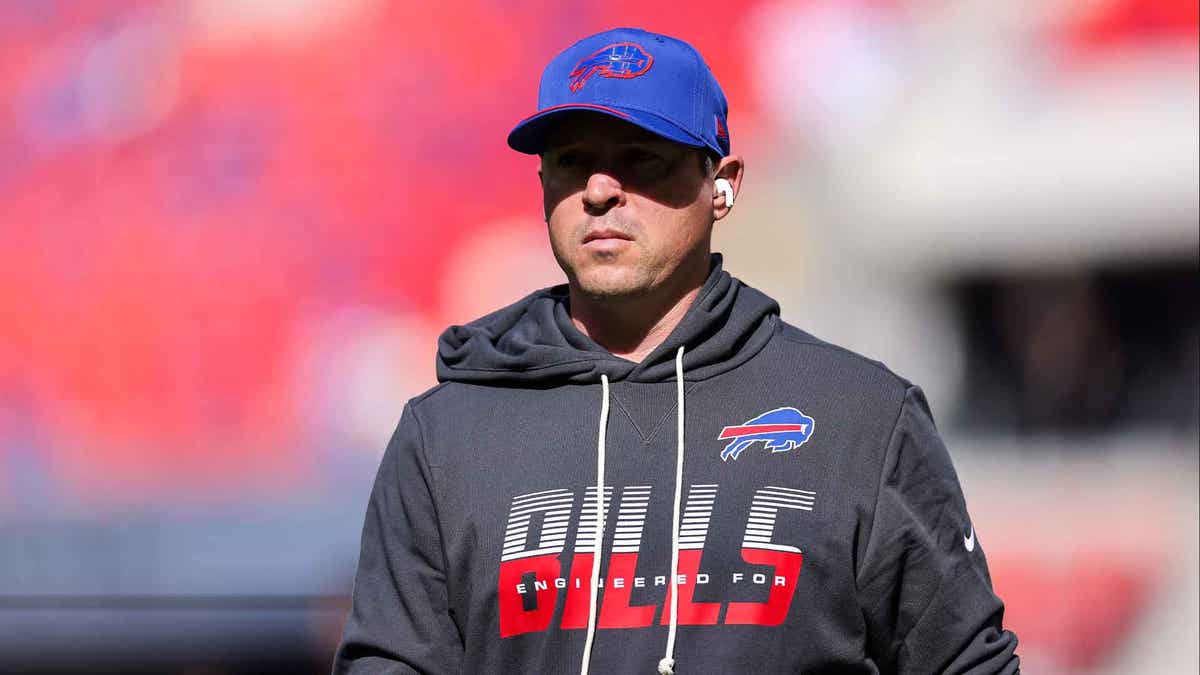
Jim Leonhard’s patience is being tested by a porous Buffalo Bills defense that’s giving up too many points, too many yards and having difficulty stopping opponents on fourth down.
And the first-year defensive coordinator is done making excuses regarding a new-look unit experiencing growing pains five weeks into the season.
“It’s time to be good at something, and that’s our struggles right now,” Leonhard said. “It’s too inconsistent to pretend that we’re building and working and making improvements. Everything’s being evaluated.”
Leonhard maintained confidence in his players, but cautioned the next step could involve roster changes.
“This is professional football. If we don’t feel like the answers are there then, yeah, then there gets to be some big conversations,” he said.
Leonhard addressed reporters over a Zoom conference call on Tuesday, a day after quarterback Josh Allen bailed out the defense in a 37-34 overtime win at the Los Angeles Rams.
The Bills (4-1) are staying in Southern California before leaving for Las Vegas to face the Raiders (3-2) on Sunday.
In thanking Allen for playing what he called the role of Superman, Leonhard said relying on the offense to carry the load isn’t a recipe for success.
“It has to change. It has to get better,” he said. “We plan on being in a lot of big games, and it’s our job as a defense to go close them out for wins.”
Familiar Issues Keep Cropping Up
And while the Rams high-octane attack presented a steep degree of difficulty, he said it doesn’t make up for the ongoing problems that continue arising.
__ Buffalo allowed 33 first downs against LA, matching the most the defense has surrendered dating to 1991. The Bills have allowed 20 or more first downs in each of their five outings, one short of last season’s total.
__ A re-shuffled secondary experienced coverage and communication issues in allowing Matthew Stafford’s 383 yards passing. The Bills have allowed 250 or more yards passing four times already, twice more than last year.
__ Fourth-down stops are a problem, with Buffalo allowing opponents to convert 8 of 9 attempts after the Rams went 2-for-2.
__ The inability to get off the field is not only reflected in Buffalo allowing the third-most yards per outing (389) and fifth-most points (141) in the NFL thus far, it’s tiring out a unit that’s played 350 snaps, the second most behind Detroit.
“You play that many snaps, it’s hard to sustain,” Leonhard said, referring to the defense playing 78 snaps on Monday — the most by Buffalo since 2023.
“We have to get some bigger wins earlier in the game,” he added. “I have to be more aggressive in helping us get off the field in some situations to help these guys not get to that fourth quarter and be burned out.”
In taking over the defense following Sean McDermott’s firing, Leonhard anticipated more from a unit entering the season making the switch to a 3-4 system and breaking in four new starters.
Though injuries have played a role, the weak spot has involved the secondary, with the starting cornerback position unsettled opposite Christian Benford. After starting the first four games, second-year player Maxwell Hairston was replaced by rookie Davison Igbinosun on Monday.
The Bills’ depth was already thin at the position in opening the season with five cornerbacks, including Dee Alford filling the nickel position.
Part of the problem, Leonard said, is players trying to do too much.
“There’s a fine line of trying harder and trying smarter,” he said. “I have that tendency. You want to do more, you want to do extra. Sometimes, it’s just relax, take a step back and simplify. Slow down.”
Reporting by the Associated Press.