
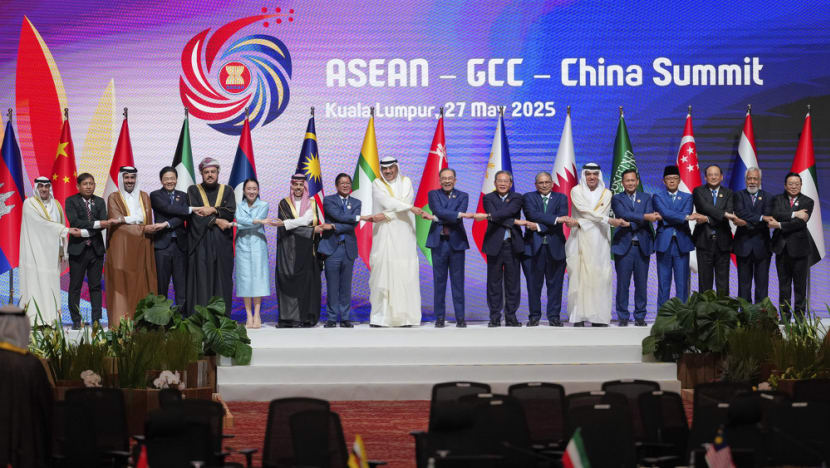
KUALA LUMPUR: Despite differences in developmental phase and civilisation background, leaders of Southeast Asian nations and several Gulf states, as well as superpower China held a historic first meeting on Tuesday (May 27), pledging to build a new model of cooperation against a backdrop of an “increasingly complex” global environment.
The inaugural Association of Southeast Asian Nations (ASEAN)-Gulf Cooperation Council (GCC)-China Summit comes as ASEAN embarks on a concerted push for new trading partners amid steep tariffs threatened by the United States.
Both China and the GCC – comprising Saudi Arabia, the United Arab Emirates, Qatar, Kuwait, Bahrain and Oman – have established partnerships with ASEAN, but this is the first time the Southeast Asian bloc has expanded a mechanism to include both a regional organisation and dialogue partner country.
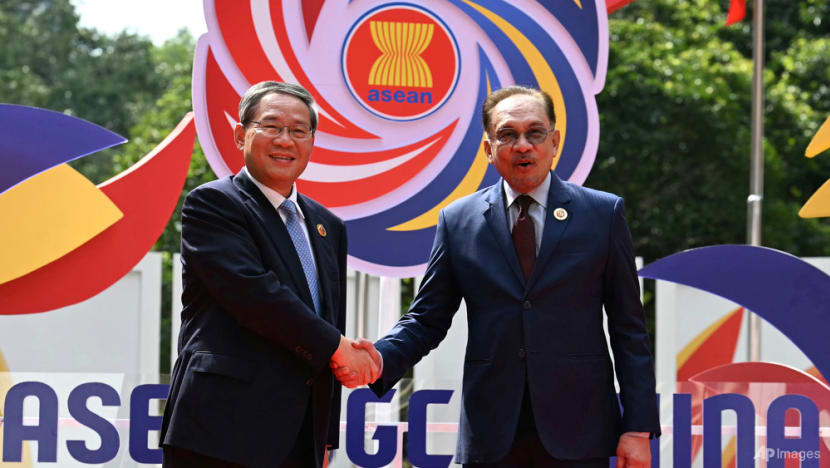
Malaysia Prime Minister Anwar Ibrahim, who as this year’s rotating ASEAN chairman had pushed for the trilateral summit, called it a “new chapter of dialogue and cooperation”.
“I hope this summit will stand as a new chapter in ASEAN’s journey of outward-looking engagement, demonstrating what can be achieved when partners work together in mutual respect and shared purpose,” he said in opening remarks at the summit.
“While existing engagements and mechanisms are well established, this format creates a new space for collaboration, as we explore pathways to synergise our strengths.”
Besides Anwar, Chinese Premier Li Qiang and the Crown Prince of Kuwait Sheikh Sabah Khaled Al-Hamad Al-Sabah – representing the GCC chairman – also made opening remarks before the closed-door summit, which was held after the ASEAN-GCC Summit earlier on Tuesday.
DEEPENING STRATEGIC ALIGNMENT
Both Anwar and Li acknowledged the historical trade links between China as well as ASEAN and GCC countries, pointing to examples like the ancient Silk Road and the current Belt and Road Initiative (BRI).
The BRI is a massive China-led infrastructure project, adopted in 2013, that aims to stretch around the globe.
“China is willing to join hands with ASEAN and the GCC to fully harness the synergy of one plus one plus one being greater than three, and inject powerful momentum into the common development and prosperity of our three sides,” Li said in his opening remarks.
Beijing is also willing, on the basis of mutual respect and equal treatment, to “deepen strategic alignment” with both ASEAN and the GCC, improve macroeconomic policy coordination, and promote closer industrial collaboration, he said.
“Our countries are at various stages of development, but I believe these differences are not obstacles to cooperation – rather, they present opportunities for complementarity,” he added.
Li also called for a model for cross-civilisational integration, citing how the three regions are home to diverse and vibrant civilisations but yet “coexist peacefully in Asia and share common Asian values of peace, cooperation, openness, and inclusiveness”.
“Through greater understanding, we can manage differences more effectively, and through shared wisdom, we can strengthen mutually beneficial cooperation — together exploring a new path of inclusive coexistence among civilisations,” he added.
Li said on Monday that China looked forward to strengthening communication and cooperation with ASEAN and GCC nations to promote peace, prosperity and stability in Asia.
He echoed these sentiments in his opening remarks, saying that the new partnership could create a “model of global cooperation and development for this era”.
“Today, against the backdrop of an increasingly complex international environment and a sluggish global economy, the establishment of this trilateral summit presents an opportunity to continuously enrich the substance of our cooperation,” he said.
The GCC’s total commodity trade with China reached almost US$298 billion in 2023 while the bloc accounted for 36 per cent of China’s total crude oil imports that year, according to United Nations figures.
That same year, trade between ASEAN and the GCC amounted to around US$130.7 billion, making the Gulf bloc ASEAN’s seventh-largest trading partner.
China, meanwhile, remained ASEAN’s largest trading partner, with US$696.7 billion in trade and US$17.3 billion in foreign direct investment in 2023.
Anwar said these figures showed “immense existing linkages as well as substantial untapped potential”.
ASEAN, the GCC and China collectively represent a combined gross domestic product of US$24.87 trillion and a population of approximately 2.15 billion, he said.
“This collective scale offers vast opportunities to synergise our markets, deepen innovation, and promote cross-regional investment,” Anwar added.
“By strengthening collaboration in these areas, we can lay the foundation for stable, resilient and sustainable growth.”
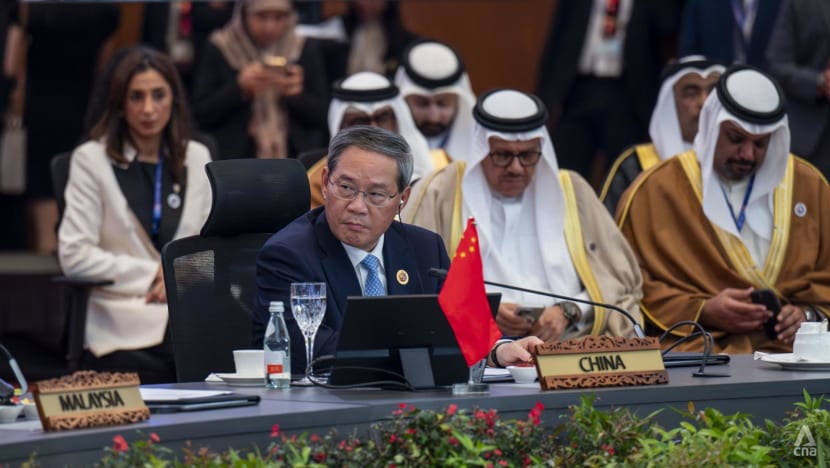
Li said China, ASEAN, and many GCC countries account for around one-quarter of the world’s total population and economic output, as he called on the slides to build a model of “cross-regional openness”, referring to the economic and developmental potential of “fully connecting” the three regional markets.
He added that China and ASEAN have already completed negotiations on the upgraded version 3.0 of the China-ASEAN Free Trade Area agreement.
“Fully connecting our markets will unleash enormous development potential and generate even greater scale effects,” he added.
ASEAN currently has dialogue partnerships with 11 parties: Australia, Canada, China, the European Union, India, Japan, New Zealand, South Korea, Russia, the United Kingdom and the US.
Leaders of ASEAN would hold separate summits with the leaders of these dialogue partners.
In addition, ASEAN leaders also have regular summits under other ASEAN-led meeting mechanisms such as the ASEAN Plus Three (Japan, South Korea and China) and East Asia Summit (ASEAN with eight other countries).
ASEAN and the GCC held their first summit in Saudi Arabia in 2023, and the second one on Tuesday morning.
The ASEAN-GCC-China summit marks the first such summit between ASEAN, one of its dialogue partners, and a third multilateral grouping.
Comments are closed.