
East Asia
“Relevant negotiations and agreements should not target or harm the interests of third parties,” said a Chinese spokeswoman.
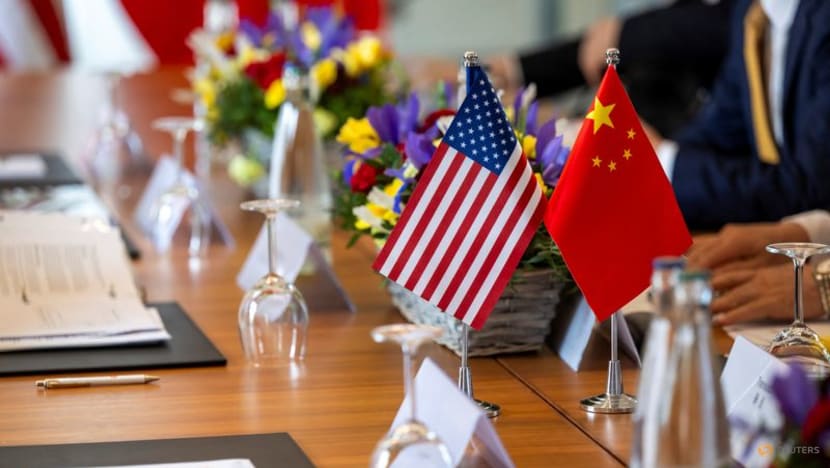
The US and China flags on the negotiating table during a bilateral meeting in Geneva, Switzerland, May 10, 2025. (File photo: Keystone/EDA/Martial Trezzini/ via Reuters)
03 Jul 2025 04:36PM (Updated: 03 Jul 2025 06:21PM)
BEIJING: China warned on Thursday (Jul 3) against trade deals that “hurt third parties” after US President Donald Trump said he had struck an agreement with Vietnam.
“China has always advocated that all parties resolve economic and trade differences through equal dialogue and consultation,” foreign ministry spokeswoman Mao Ning said.
“At the same time, relevant negotiations and agreements should not target or harm the interests of third parties,” she said.
The deal announced on Wednesday is the first full pact Trump has sealed with an Asian nation, and analysts say it may give a glimpse of the template Washington will use with other countries still hoping for accords.
It comes less than a week before Trump’s self-imposed Jul 9 deadline for steeper tariffs on US trade partners to take effect if agreements are not reached.
“PROVOCATION”
Trump said the US will place a 20 per cent tariff on many Vietnamese exports, down from the initial 46 per cent levy announced in April.
However, a 40 per cent tariff will also hit goods passing through the country to circumvent steeper trade barriers – a practice called “transshipping”.
Trump’s trade adviser Peter Navarro has called Vietnam a “colony of China”, saying that one-third of Vietnamese products are relabelled Chinese goods.
Raw materials from the world’s number two economy are also the lifeblood of Vietnam’s manufacturing industries
“From a global perspective, perhaps the most interesting point is that this deal again seems in large part to be about China,” said Capital Economics.
It said the terms on transshipment “will be seen as a provocation in Beijing, particularly if similar conditions are included in any other deals agreed over (the) coming days”.
Beijing’s commerce ministry said on Thursday it had “always firmly opposed” US tariffs.
“China’s position is consistent,” He Yongqian, spokeswoman for China’s ministry of commerce, told a briefing.
“We are happy to see all parties resolve economic and trade differences with the United States through equal consultations, but we firmly oppose any party reaching a deal at the expense of China’s interests,” she said.
“THE LOOMING QUESTION”
Shares in clothing companies and sports equipment manufacturers, which have a large footprint in Vietnam, rose on news of the deal in New York.
But they later declined sharply as details were released.
“This is a much better outcome than a flat 46 per cent tariff, but I wouldn’t celebrate just yet,” said Hanoi-based Dan Martin of Asian business advisory firm Dezan Shira & Associates.
“Everything now depends on how the US decides to interpret and enforce the idea of transshipment,” he added.
“If the US takes a broader view and starts questioning products that use foreign parts, even when value is genuinely added in Vietnam, it could end up affecting a lot of companies that are playing by the rules.”
Vietnam’s government said in a statement late on Wednesday that under the deal, the country had promised “preferential market access for US goods, including large-engine cars”.
But the statement gave scant detail about the transshipment arrangements in the deal, which Trump announced on his Truth Social platform.
Bloomberg Economics forecast Vietnam could lose a quarter of its exports to the US in the medium term, endangering more than 2 per cent of its gross domestic product as a result of the agreement.
Uncertainty over how transshipping will be “defined or enforced” is likely to have diplomatic repercussions, said Bloomberg Economics expert Rana Sajedi.
“The looming question now is how China will respond,” she said. “Beijing has made clear that it would respond to deals that came at the expense of Chinese interests.”
“The decision to agree to a higher tariff on goods deemed to be ‘transshipped’ through Vietnam may fall in that category,” added Sajedi.
“Any retaliatory steps could have an outsized impact on Vietnam’s economy.”
Comments are closed.