
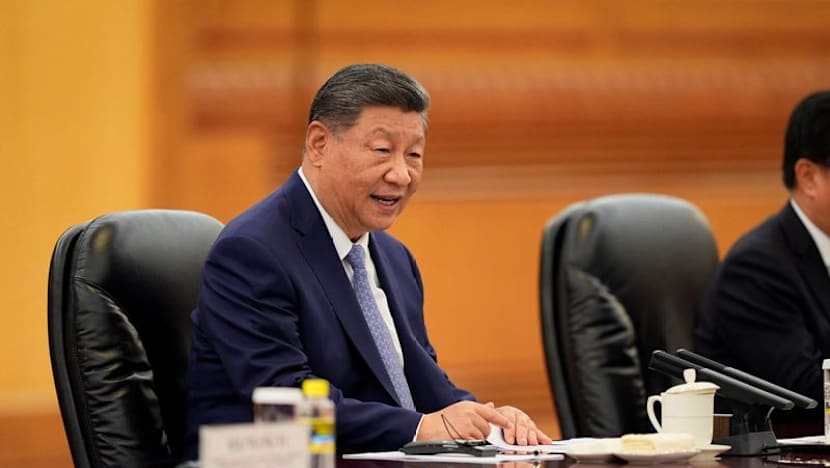
BEIJING: On the cusp of a potential meeting with United States President Donald Trump, Chinese President Xi Jinping has challenged China to seize the “window of opportunity” to consolidate and build on its strengths, and secure the “strategic initiative” amid intense global competition.
These include removing development bottlenecks, shoring up areas of weaknesses, and securing major breakthroughs in the country’s modernisation efforts, he said in remarks released on Tuesday (Oct 28) as he explained the key recommendations of China’s newly adopted 15th Five-Year Plan.
“All of this will allow us to secure decisive progress toward basically achieving socialist modernisation,” Xi added.
And as the international landscape becomes increasingly challenging and complex, the president said China must “move faster” to create a new development pattern and keep a firm hold on the initiative in development.
“At present and for some time to come, China must work to strengthen the domestic economy and boost domestic economic flows, so as to leverage the stability of the domestic economy as a ‘hedge’ against the uncertainties in the international economy,” he added.
Xi and Trump are touted to meet at the APEC Summit in South Korea, in a bid to seal a deal to end the bruising trade war between the world’s two biggest economies.
It will be their first meeting since Trump began his current second term in January this year.
STRATEGIC SUPPORT FOR THE PRIVATE SECTOR
Beijing also formally announced on Tuesday the Communist Party’s Central Committee proposal for the nation’s 15th Five-Year Plan.
The proposal included language that signals strategic support for the private sector and an acceleration of China’s transformation into a financial power, easing market concerns about their positions in the economy over the next five years.
These messages were not mentioned in the communique published last week at the end of the fourth plenum of the Communist Party, the South China Morning Post reported.
In the proposal, it stated that “the state should implement the Private Economy Promotion Law to ensure, through legal and institutional means, equal access to production factors, fair participation in market competition, and effective protection of legitimate rights and interests, so as to develop and expand the private economy”.
It vowed to “fully stimulate” the vitality of all types of business entities and encourage the joint development of various forms of ownership.
The proposal also called for a more “sound and standardised” mechanism for law enforcement involving companies, cautioning against unlawful cross-regional enforcement and profit-driven enforcement.
The recommendation could be seen as part of Beijing’s efforts in recent years to court private business owners and boost confidence in the private sector amid an economic slowdown.
It also pushed for increased private capital access in key infrastructure projects, under the guidance of public funds.
Comments are closed.