
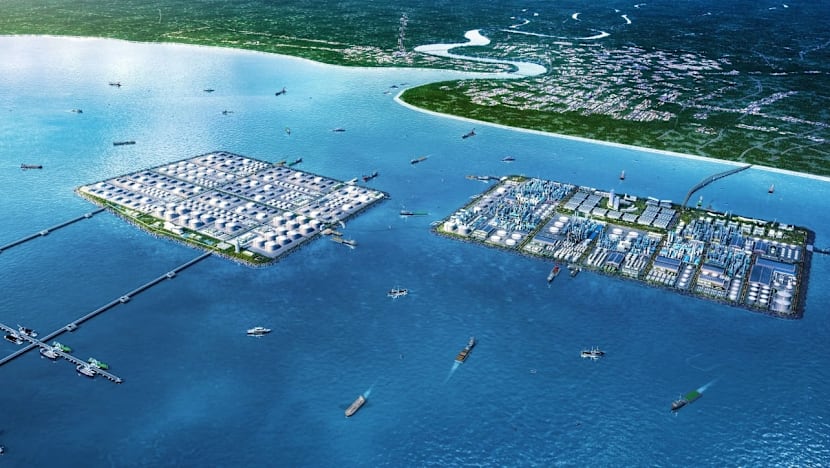
JOHOR BAHRU: Malaysia’s newly launched Maharani Energy Freeport in Johor is positioning itself as a deep-water alternative to Singapore, targeting the lucrative flow of oil tankers that make up one-fifth of global crude shipments through the Strait of Malacca.
Built on three purpose-built reclaimed islands off Muar, the project aims to develop into a zero-tax freeport for energy trading, storage, ship-to-ship (STS) operations and bunkering.
With natural water depths exceeding 24m, the hub is marketed as one of the few locations in the region capable of accommodating fully-loaded Very Large Crude Oil Carriers (VLCCs) without dredging.
A VLCC is a vessel designed to transport crude oil, capable of carrying around 200,000 to 320,000 tonnes of oil per voyage.
However, shipping and logistics experts told CNA that Maharani’s biggest challenge is competition in the region, including from its neighbour across the Johor Strait.
Singapore remains the world’s dominant bunkering and oil-trading hub, supported by major refinery complexes, decades of regulatory credibility and the presence of trading giants such as Shell, Trafigura and Vitol.
Nearby Indonesian anchorages around Batam, Karimun and Nipah (the Riau islands) have also carved out a strong niche for STS transfers, while storage facilities in Tanjung Uban (Bintan) attract tankers looking for cheaper re-export options.
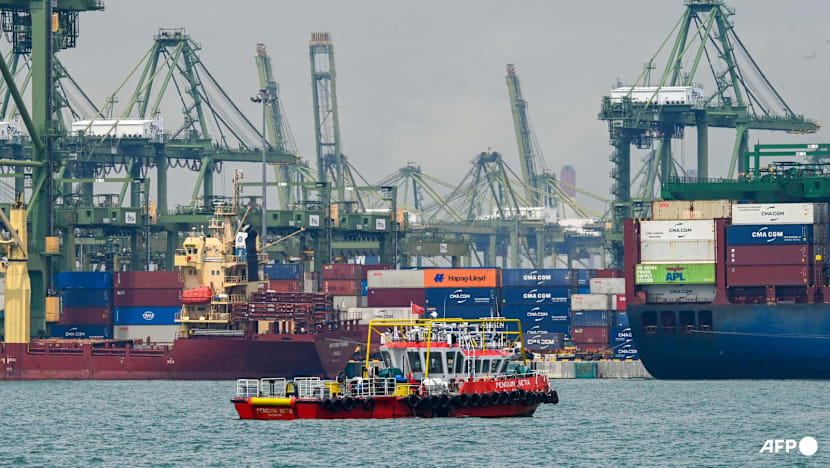
Despite this, analysts say Maharani’s aggressive tax incentives — including zero corporate tax for most operators and a 3 per cent rate for oil traders — give it a pricing edge.
Maritime and logistics scholar Nazery Khalid told CNA that the launch of the freeport is evidence that Malaysia “no longer wants to be at the periphery of competition” and is offering a hub that could put it in direct competition with Singapore over the next decades.
“When you have a big facility like this – offering connectivity to the region and strong tax incentives, it will naturally attract shipping lines in the tanker trade, investors and players in the energy sector. They are drawn to freeports with such characteristics the way bees are attracted to nectar,” said Nazery who is also adjunct professor at three Malaysian universities.
But experts maintained that the port will need to boost infrastructure readiness and operational reliability before it can meaningfully draw traffic away from established rivals.
CENTRE OF EAST-WEST TRADE ROUTE
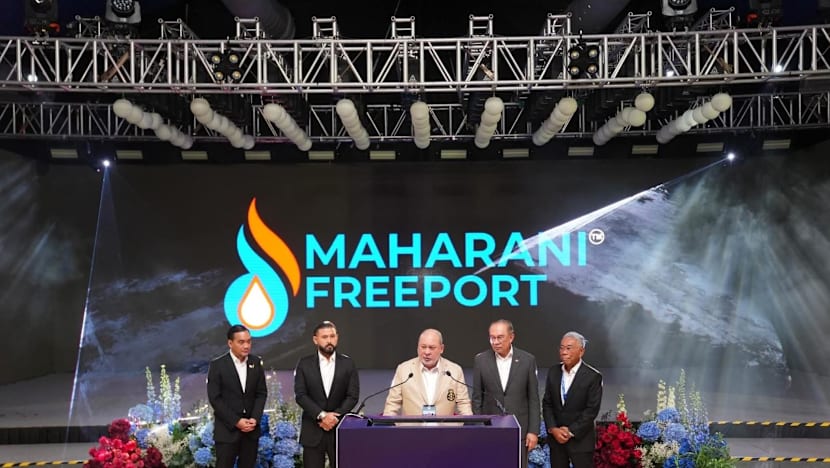
The Maharani Freeport was launched to much fanfare in an opening ceremony in Muar last Saturday (Nov 29), with both Malaysia’s king Sultan Ibrahim Sultan Iskandar and Prime Minister Anwar Ibrahim in attendance.
The former, who is also Johor’s ruler, has a 40 per cent stake in the project’s developer company Maharani Energy Gateway.
In his speech at the event’s launch, Anwar said the project could create 45,000 employment opportunities, attract supporting industries, and open doors for small and medium enterprises, enhancing Malaysia’s logistics competitiveness in global supply chains.
The port spans 3,200 acres, equivalent to roughly 1,800 football fields, and is strategically located in the middle of the Straits of Malacca – renowned as the world’s busiest oil highway carrying millions of barrels of oil per day and around a hundred thousand oil tankers per year.
Nazery told CNA that its location off Muar’s coast is strategically en route for carriers from the Middle East heading to East Asia such as China and Japan.
In 2024, then-Malaysian trade minister Tengku Zafrul Abdul Aziz had said that the project was “strategically positioned right in the centre of the East-West trade route”.
“It is only five sailing days away from China, an important market for oil and gas, and also 28 sailing days to the Middle East, and 38 days to the Black Sea,” he had said.
Experts added that Maharani’s main competitor, the Port of Singapore, is also strategically located on the southern exit of the Malacca Strait – the natural chokepoint where ships slow for bunkering and resupply.
The Port of Singapore includes terminals at Tanjong Pagar, Keppel, Brani, Pasir Panjang, Sembawang, Jurong and the new Tuas Port. They are regulated and operated by the Maritime and Port Authority of Singapore.
However experts added that Maharani could have an edge as its slightly deeper depth makes it easier for VLCCs and has currently less congested waters, which offers potentially shorter waiting times.
The maximum depth for waters in Port of Singapore is roughly 21 metres at the Tuas Mega Port.
“Malaysia will be able to host some of the world’s largest crude carriers passing through the route and (because of its deep waters and off-coast location) it can offer a floating terminal, do ship repairs and serve as a hub for oil and gas trading,” Nazery added.
Political and economic commentator Nazri Hamdan told CNA that Maharani’s location and depth makes it a regional “game-changer” for oil trading, storage, bunkering, blending and deep-sea port services.
“Johor automatically enters the league of countries that have global energy hubs on par with Fujairah (in the United Arab Emirates), Jurong (in Singapore) and Rotterdam (in the Netherlands),” he said.
Another comparative advantage it offers is costs, experts said.
Maharani’s freeport status and low tax rates makes it a potentially more cost-effective choice than its competitors.
At the Port of Singapore, consisting of berths operated by PSA Singapore and Jurong Port, oil tankers are typically subjected to higher docking and service fees, analysts said.
Furthermore, most of Maharani’s direct competitor ports in Indonesia in the Riau province – such as Nipah Anchorage and Tanjung Uban – do not offer freeport status, and tankers passing through are not exempt from custom duties.
“Maharani’s tax incentives will put Malaysia in direct competition with Singapore,” added Nazery.
Nazery added that Maharani is also unique in Malaysia as it predominantly targets VLCCs while other key Malaysian ports like Port Klang in Selangor and Port of Tanjung Pelepas in southern Johor handle predominantly shipping containers.
Experts added that the Pengerang Integrated Petroleum Complex in southeast Johor handles oil tankers but its focus is more on refining than trading, and it is not a freeport, with companies subjected to oil terminal taxes.
Nazery told CNA: “Malaysia had not been able to leverage its strategic location at the heart of a key shipping lane, the Straits of Malacca, and capitalise on the huge number of oil and gas vessels traversing through owing to a lack of facilities and one-stop services.”
“The establishment of the Maharani Freeport is therefore a visionary project which will enable Malaysia to capitalise on the lucrative and huge volume of energy carriers sailing through its backyard,” he added.
However, experts warn that Maharani Freeport is still untested and needs to build a reputation and operational consistency.
The Port of Singapore meanwhile, is integrated with global traders like Shell, Vitol and Trafigura and already handles around 20 per cent to 25 per cent of global marine fuel sales annually, they said.
Maritime transport and logistics expert and consultant Durairaj Govindasamy told CNA that Muar is not a proven logistics or maritime node, and would grapple to win the trust of established oil traders who have long passed through Singapore.
“Muar lacks … industrial clusters, logistics hubs, and hinterland multimodal connectivity,” said Govindasamy, who is Malaysia-based and teaches logistics and supply chain management at universities in The Philippines.
Experts added that some Indonesian ports have also served as established bases for key oil companies and are more operationally mature than Maharani.
They pointed out that Nipah Anchorage in the Riau islands for example is among the world’s busiest STS transfer points for crude oil and is used heavily by Middle Eastern crude bound for China.
Tanjung Uban in Bintan is also regarded as a major fuel storage cluster and has strong links with Singapore fuel traders, experts said.
Govindasamy stressed that the densest shipping lanes of the Malacca Strait run closer to the Singapore – Port Klang axis – away from the Muar coastline. Port Klang is located in Selangor, around 200km north of Muar.
“There must be a compelling enough reason for companies to divert traffic and change ship lanes,” he added.
Govindasamy, who has worked on a national logistics roadmap and trade facilitation master plans for the Malaysian Government, added that while Maharani Freeport could represent a strategic leap, the project “lacks demonstrable demand” and “proven maritime advantages”.
While Maharani has some advantages like depth, less congested waters and potentially lower costs, experts added that it lacks refinery infrastructure for alternative fuel, which Nazery stressed was crucial for Maharani Freeport to compete.
He also noted the need for Malaysia as a whole to move away towards “cleaner energy” given the dynamics of future energy flow in the region, away from crude oil to alternative sources.
“The world is shifting towards cleaner energy sources, so the refinery infrastructure at Maharani cannot just be focusing on crude oil and gas, it needs to start looking at facilitating storage, transportation and handling of ships carrying alternative energy like ammonia and hydrogen,” he added.
The Maharani Freeport project had included plans to develop a green hydrogen and ammonia plant through collaboration with Chinese firm China Energy International Group (CEIG).
However, it is uncertain as to when the plant will be ready.
There are also concerns that the land reclamation for this project has triggered environmental issues.
In 2022, before the project was completed, various media reports outlined how the reclamation has depleted seafood catch for local fishermen in the area, impacting their livelihoods and also damaging the marine ecosystem.
Muar member of parliament Syed Saddiq Abdul Rahman was among those who were vocal, reportedly saying that the fishermen were not consulted and they should receive compensation as their livelihoods had been impacted.
President for environmental group Sahabat Alam Malaysia Meenakshi Raman told CNA that now that the project has launched, it reflects “poor governance” and how the voices of common folk including local fishermen and activists had been “drowned out”.
“This used to be a thriving area for fishing as it has restaurants that tourists come to from all over, including Singapore. It’s unfortunate that this community who are really on the front line of this project has been ignored,” she said.
CNA has reached out to the project’s developer Maharani Energy Gateway for comment on plans to develop a refinery as well as whether there are efforts to assess and mitigate its environmental impact on the marine ecosystem and local communities.
Experts told CNA that environmental issues aside, the bigger picture for the Maharani Freeport now is whether it can remain competitive and yield investments and jobs as promised.
They added that with rising shipping congestion in the area, including in Singapore, it could open a window for Johor to capture spillover demand and secure a long-elusive foothold in the global energy supply chain running through the Strait of Malacca.
Nazery said: “I’m sure (Maharani) will eventually elevate the offerings they have on the menu to become a one-stop strategic gateway capable of delivering a whole spectrum of energy logistics services to position Malaysia as a key player in the Asia Pacific region.”