
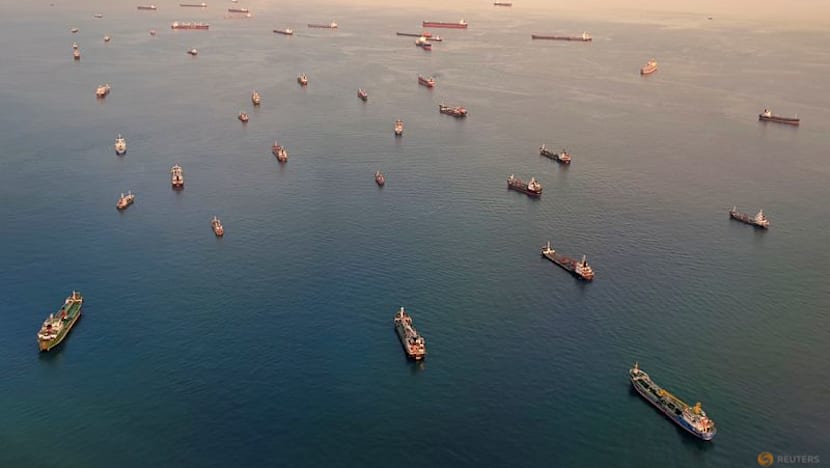
SINGAPORE: Rogue tankers carrying sanctioned oil and other restricted goods are a growing presence in waters off Singapore, raising safety concerns in one of the world’s busiest shipping lanes.
The wars in Ukraine and the Middle East have pushed more of these vessels into the region, according to observers.
Fresh data from maritime intelligence firm Lloyd’s List Intelligence showed at least 27 of these so-called “shadow fleet” vessels transiting the Singapore Strait as of Thursday (Dec 4), with another 130 in the nearby Riau Archipelago.
These ships transport sanctioned cargo, often using stolen identities and other tactics to hide their activities and evade scrutiny.
The Maritime and Port Authority of Singapore (MPA) said it is monitoring vessel movements and ship-to-ship transfers in its waters.
STRATEGICALLY VITAL WATERWAY
The Singapore Strait is a vital artery for global maritime trade. More than 80,000 vessels pass through it each year, carrying about one-third of the world’s traded goods.
While little may seem unusual on the surface, shipspotters like Remy Osman have noticed a rising number of these dark fleet vessels.
“When I started the hobby, there were almost none that I saw. But then, particularly in the past year or two, I see them almost every single day,” he said.
“That’s because, since the Ukraine war started, and then (with) everything that’s happening with Iran and the Middle East, there are many more ships which have been sanctioned for taking oil from these countries and exporting them.”
Mr Remy told CNA that such ships typically change their flags frequently, falsify their registration details and sometimes switch off their tracking systems to keep sanctioned cargo flowing.
Shadow fleet tankers pass Singapore almost daily, typically heading to international waters in the South China Sea, east of Malaysia.
There, they conduct risky ship-to-ship transfers of oil and other goods – often at night and with minimal oversight.
To avoid detection, many spoof their locations to appear off Singapore while operating far away.
They also hide behind flags of convenience, turning to registries with looser oversight, making enforcement harder and insurance arrangements even murkier.
“They’re now being registered in landlocked countries or tiny countries that have no capacity whatsoever to regulate them, and they have no interest in regulating them,” said Emeritus Professor Robert Beckman, head of the ocean law and policy programme at the National University of Singapore’s Centre for International Law.
“They’re simply doing it to make money,” he told CNA’s Singapore Tonight programme.
TAKING ON STOLEN IDENTITIES
Some shadow fleet tankers keep their real names but sail under sanctions or without proper insurance.
Others are “zombie ships” that assume the identities of decommissioned ships, making them difficult to trace.
Every ship in or passing Singapore must broadcast its identity and route using the Automatic Identification System (AIS), which relays key details – including a vessel’s name, registration number, origin and destination – to the port authority, global trackers and nearby vessels.
But because the AIS can be manually configured, it is vulnerable to manipulation.
Shadow operators can reprogramme a vessel’s AIS to revive the discarded identity of a scrapped ship.
Zombie ships may repaint their hulls, change flags and adopt new names to imitate legitimate ships and blend into surrounding traffic, even as they move oil from sanctioned countries such as Russia and Iran.
UNINTENDED CONSEQUENCES
While many shadow fleet ships sail through the Strait without stopping, questions remain over what Singapore can do.
“What they’re doing is actually exercising their right of innocent passage through the Singapore Straits,” said Mr Mathiew Rajoo, partner at maritime and commercial law firm DennisMathiew.
“You have to bear in mind that the Singapore Straits is actually a traffic separation scheme that is adopted by the International Maritime Organization,” he added, referring to the routing system that manages ships travelling in opposite directions.
Although most shadow fleet vessels pass through without issues, analysts say they act as “risk multipliers” in one of the world’s busiest shipping lanes.
The larger concern arises when these typically uninsured vessels are involved in accidents, said Mr Mathiew, leading to unintended consequences like oil spills.
A major tanker spill could cost up to US$1.6 billion in response and cleanup alone.
In Southeast Asia, cleanup costs are estimated at about US$16,000 per tonne of oil.
Yet changing international law may not be straightforward.
“When the United Nations Convention on the Law of the Sea was agreed by the parties, at that time, we didn’t have this problem of shadow fleet,” said Mr Mathiew.
“This problem was not in their minds,” he added.
“So maybe the better way to deal with this is to go and amend the convention to address this type of risk, because they are real risks, and you cannot afford to have a pollution incident from the shadow fleet.”
Singapore fully implements the UN resolutions, including sanctions imposed through domestic legislation, and the MPA monitors all vessel movements in Singapore waters.
Ship-to-ship transfers here without MPA’s approval are not allowed, and Singapore is working with neighbouring countries to combat illicit maritime activities in the Straits of Malacca and Singapore.