
BANGKOK: Thailand said it was taking action to expel Cambodian forces from its territory on Tuesday (Dec 9), as renewed fighting between the two Southeast Asian neighbours spread along their disputed border.
Each side has blamed the other for the clashes, which have derailed a fragile ceasefire brokered by United States President Donald Trump that ended five days of fighting in July. Trump has urged both sides to honour the truce.
Cambodia’s Defence Ministry said two civilians had been killed overnight, taking its death toll to six. One Thai soldier has died in the fighting.
In a statement on Tuesday morning, the Thai Navy said Cambodian forces had been detected inside Thai territory in the coastal province of Trat and military operations were launched to expel them, without providing further details.
Cambodian Prime Minister Hun Manet said late on Monday that Thailand “must not use military force to attack civilian villages under the pretext of reclaiming its sovereignty”.
Earlier, Cambodia said it had not retaliated even after its forces came under sustained attack.
The Thai Navy said Cambodian forces were increasing their presence, deploying snipers and heavy weapons, improving fortified positions and digging trenches, adding it saw the actions “as a direct and serious threat to Thailand’s sovereignty”.
A senior Trump administration official said on Monday that the US president expects Cambodia and Thailand to “fully honour” their ceasefire commitments following the renewed clashes.
“President Trump is committed to the continued cessation of violence and expects the governments of Cambodia and Thailand to fully honour their commitments to end this conflict,” said the official, who spoke on the condition of anonymity.
Earlier, Thailand said its fighter jets struck Cambodia on Monday in an attempt to cripple its military capability.
Cambodia accused Thailand of “inhumane and brutal acts” of aggression, stressing it had not retaliated, while Bangkok said it carried out airstrikes on military targets after its neighbour mobilised heavy weaponry and repositioned combat units.
“The objective of the army is to cripple Cambodia’s military capability for a long time to come, for the safety of our children and grandchildren,” Thai army chief of staff General Chaipruak Doungprapat said, according to the military.
The fighting was the fiercest since a five-day exchange of rockets and heavy artillery in July that marked their heaviest clashes in recent history, when at least 48 people were killed and 300,000 displaced before Trump intervened to broker a ceasefire.
“THERE WILL BE NO TALKS”
Tensions have simmered since Thailand last month suspended de-escalation measures that were agreed at a summit in Trump’s presence, after a Thai soldier was maimed by a landmine that Bangkok said was newly laid by Cambodia.
Some of the mines that have wounded seven Thai soldiers since July were likely newly laid, Reuters reported in October, based on expert analysis of material shared by Thailand’s military.
Cambodia has denied laying the mines and Thailand has said it will not implement the ceasefire terms until Cambodia apologises.
Thai Prime Minister Anutin Charnvirakul on Monday said his government would do whatever necessary to protect its territorial integrity and would not engage in dialogue with Cambodia.
“There will be no talks. If the fighting is to end, (Cambodia) must do what Thailand has set,” he said, without elaborating.
Cambodia’s defence ministry said its forces came under sustained attack, but were committed to the ceasefire and did not retaliate.
“Cambodia calls on the international community to strongly condemn Thailand’s violations … as well as demands that Thailand take full responsibility for such brazen acts of aggression,” it said in a statement.
Thailand’s army said Cambodia used drones to drop bombs on Thai bases and fired truck-mounted BM-21 rockets towards civilian areas. A Thai military official told Reuters targets of airstrikes included long-range Chinese-made rockets.
Malaysian Prime Minister Anwar Ibrahim, chair of the regional Association of Southeast Asian Nations bloc, who helped Trump broker the truce, called for calm and for communication channels to stay open.
“The renewed fighting risks unravelling the careful work that has gone into stabilising relations,” Anwar said in an X post.
United Nations Secretary-General Antonio Guterres urged Thailand and Cambodia to exercise restraint and avoid further escalation, said his spokesperson, adding: “The United Nations stands ready to support all efforts aimed at promoting peace, stability, and development in the region.”
EXPLOSIONS
Cambodia’s former long-time leader Hun Sen, the influential father of current premier Hun Manet, said Thailand’s military was seeking to provoke a retaliatory response.
“All frontline forces must remain patient because the aggressors have been firing all kinds of weapons,” he said on Facebook.
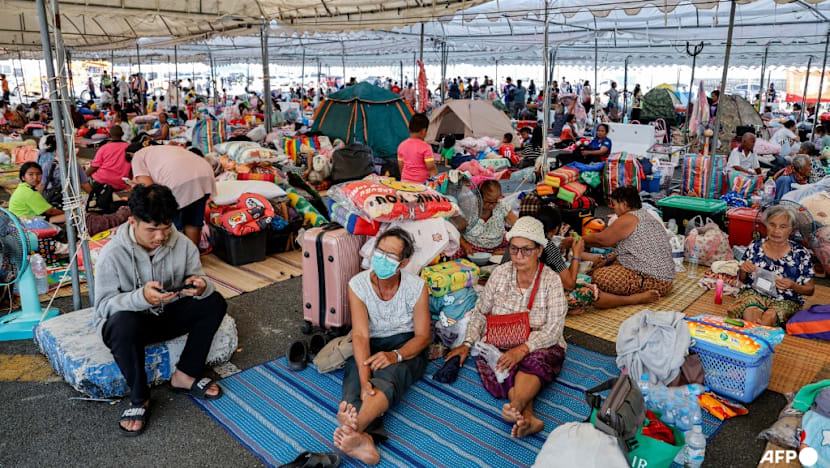
Thailand evacuated 438,000 civilians across five border provinces and authorities in Cambodia said hundreds of thousands of people had been moved to safety. Thailand’s army said 18 soldiers were wounded and Cambodia’s government reported nine civilians injured.
In Cambodia, bottlenecks of trucks and cars formed on country roads and streams of motorcycles and farming vehicles were leaving border areas, local television showed. A verified eyewitness video showed a plume of smoke rising after a Thai airstrike.
Thai television showed footage of people packed into evacuation camps and others sheltering in bunkers or large concrete water pipes, and the military released a video of what it said was exploding Cambodian artillery.
Phichet Pholkoet, a resident of Thailand’s Ban Kruat district bordering Cambodia, said he had heard gunfire since early morning.
“It startled me. The explosions were very clear. Boom boom!” he said via telephone. “I could hear everything clearly. Some are heavy artillery, some are small arms.”
BITTER HISTORY
The use of fighter jets demonstrates Thailand’s military advantage over Cambodia, with armed forces that dwarf its neighbour in terms of personnel, budget and weaponry.
Thailand and Cambodia have for more than a century contested sovereignty at undemarcated points along their 817km land border, with disputes over ancient temples stirring nationalist fervour and occasional armed flare-ups, including a deadly week-long artillery exchange in 2011.
Tensions rose in May following the killing of a Cambodian soldier during a skirmish, which led to a major troop buildup at the border and escalated into diplomatic breakdowns and armed clashes.