
Asia
Analysts say it is difficult to ascertain who triggered the latest hostilities amid conflicting claims, swirling speculation and limited transparency from both governments.
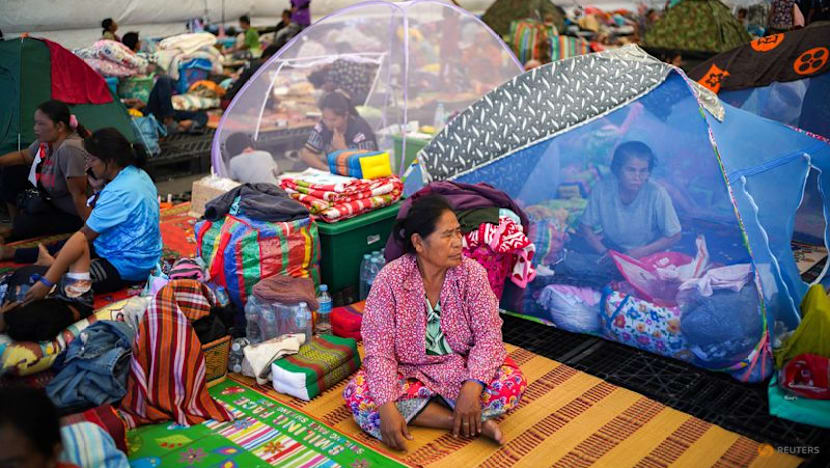
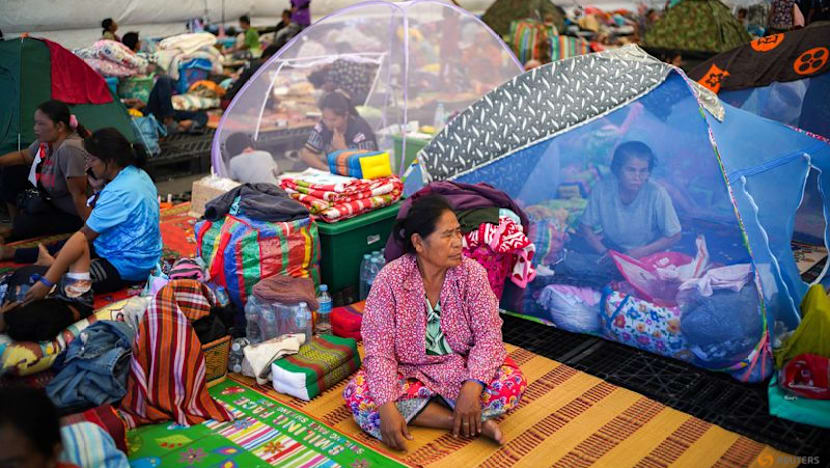
Displaced people gather inside a temporary shelter amid deadly clashes between Thailand and Cambodia along a disputed border area, in Buriram province, Thailand, Dec 9, 2025. (Photo: Reuters/Athit Perawongmetha)
New: You can now listen to articles. 
This audio is generated by an AI tool.

09 Dec 2025 06:24PM
Fighting has surged once again along the long-contested border between Thailand and Cambodia, exposing the fragility of recent peace efforts.
Analysts said it is difficult to determine who triggered the renewed hostilities amid conflicting claims, swirling speculation and limited transparency from both governments.
What is clear, however, is that the return to violence signals an unravelling of the peace framework signed just six weeks ago, they added.
A PEACE ACCORD “IN TATTERS”
In October, Thai and Cambodian leaders signed a joint declaration of peace on the sidelines of the Association of Southeast Asian Nations (ASEAN) summit in Kuala Lumpur.
The deal was brokered and witnessed by Malaysian Prime Minister Anwar Ibrahim, the current chair of the regional bloc, together with United States President Donald Trump.
The accord had been envisioned as a roadmap towards lasting peace, including the withdrawal of troops and heavy weapons.
But analysts said the agreement was flawed and fragile from the outset – and is now effectively “on its last legs”.
“The peace accord is pretty much in tatters at this point,” said independent political advisor Jay Harriman, arguing that the truce never addressed the core drivers of conflict.
“It was more or less foisted upon the two sides by Trump, without dealing with any of the underlying factors – disputed religious temples, border demarcation, ultra nationalism and complicated domestic politics.”
Erik Martinez Kuhonta, an associate professor of political science at McGill University, concurred. He noted that Thailand showed little enthusiasm early on but likely accepted the deal under tariff pressure from Washington.
He said he believes that within Thailand, powerful factions in the military oppose the ceasefire entirely.
“The decision-making process isn’t always fully controlled by civilian decision makers. In Thailand, there’s been much rancour in the military (around) the ceasefire – it feels it lost strategic ground by having to pause the fighting,” he told CNA’s Asia First programme.
Kuhonta said Thailand holds a decisive military advantage over its neighbour, pointing out that Bangkok’s defence budget is more than four times that of Phnom Penh’s, with far superior assets, including F-16 fighter jets already deployed against Cambodian positions.
“Thailand simply has that air power that Cambodia doesn’t have, and Cambodia cannot retaliate with the same kind of force,” he said.
“So, regardless of who started this latest clash … Thailand’s firepower will determine the outcome. And from the rhetoric coming out of (Prime Minister) Anutin Charnvirakul and other Thai politicians, it’s very clear that Thailand wants to push this hard.”
CAN ASEAN STEP IN?
With the situation deteriorating, analysts agree that ASEAN must attempt to reduce tensions – but their assessments diverge on how effective the bloc can realistically be.
“ASEAN has to play a stronger role here … ASEAN is the regional body closest to the conflict. Anwar has shown that he really wants to play an important role as leader of the region, and here’s an opportunity,” Kuhonta said.
But Harriman remains sceptical.
He noted that major external powers – particularly the US and China – are better positioned to exert meaningful pressure.
While ASEAN successfully convened parties for the October truce, the organisation’s long-standing principle of non-interference limits its ability to intervene in the dispute.
“It’s difficult for ASEAN to move the needle much going forward. It is really contingent upon Cambodia’s and Thailand’s political decision makers being ready to make that commitment,” Harriman told CNA938.