
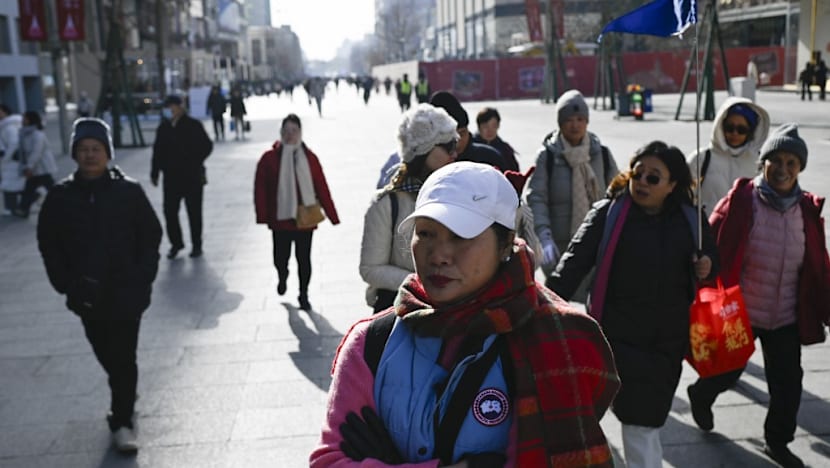
Lower energy prices and cheaper Chinese goods are helping households in the region pull ahead of rising costs for the first time in years, Mastercard’s Asia Pacific chief economist David Mann told CNA.
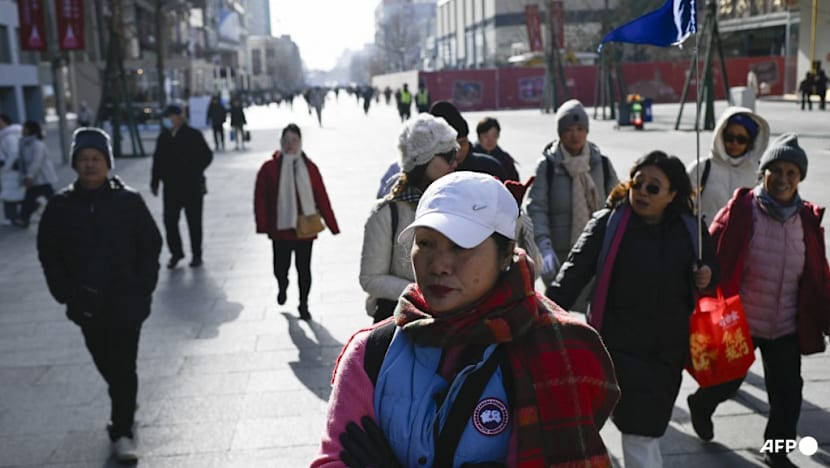
A group of tourists visits a shopping street in Beijing on Nov 28, 2025. Travel is expected to remain one of Asia-Pacific’s strongest engines of growth in 2026, according to the latest annual outlook from the Mastercard Economics Institute. (Photo: AFP/Wang Zhao)
New: You can now listen to articles. 
This audio is generated by an AI tool.

10 Dec 2025 05:33PM
SINGAPORE: The Asia Pacific region is poised to remain a relatively bright spot in 2026 even as the global economy confronts geopolitical tensions, shifting trade dynamics and accelerating artificial intelligence investment, according to the latest annual outlook from the Mastercard Economics Institute (MEI).
In a statement on Wednesday (Dec 10), MEI said that Asia Pacific’s growth will be supported by easing inflation, more accommodative monetary policy and rising real incomes.
It noted that consumers will remain value-conscious, while prioritising experiences such as travel and live events.
Globally, real gross domestic product (GDP) growth is expected to ease slightly to 3.1 per cent next year from an expected 3.2 per cent in 2025.
Fiscal stimuli and technological advances – especially around AI – are expected to lift growth, though the gains will vary widely across regions, MEI said.
“Given its centrality to global trade, Asia Pacific has shown remarkable resilience at a time when tariff uncertainty and shifting supply chains have threatened to upend international commerce,” said David Mann, Mastercard’s chief economist for Asia Pacific, in the statement.
He noted the region’s next phase of growth will depend on how effectively governments and businesses adjust, strengthen their digital capabilities and respond to shifting consumer behaviour.
MEI’s 2026 outlook draws on payment giant Mastercard’s aggregated and anonymised transaction data, a range of public sources, and the institute’s own economic modelling. It covers 12 markets across Asia and Oceania.
ASIA PACIFIC DEFYING GLOBAL HEADWINDS
In a separate interview with CNA’s Asia First programme, Mann noted that lower energy prices and cheaper goods from China are improving consumers’ purchasing power in the region, helping them pull ahead of rising costs.
“We’ve been seeing for a few years, in some places, the cost of essentials had been rising so much relative to wages. But now we’re seeing wage growth exceeding CPI (consumer price index) inflation,” he added.
According to the outlook, Asia Pacific’s position at the centre of global supply chains “remains intact”, and that India, Southeast Asia and China are expanding their roles as firms adjust sourcing and investment strategies.
With China diversifying its exports to new markets in response to tariffs, America’s share of Chinese e-commerce sales fell from 28 per cent in 2024 to 24 per cent by August 2025, it added.
Coupled with softer domestic demand, Chinese firms are also increasingly looking across Asia Pacific for growth opportunities, Mann said.
As a result, locating production in and selling to markets such as the Association of Southeast Asian Nations (ASEAN) or India makes sense for Chinese companies, he added.
But while countries importing low-cost goods from China are seeing lower prices, exporters in Japan and parts of South Asia face pressure from US tariffs and softer external demand, the institute said.
RESILIENCE IN CHINA AND INDIA
Mainland China’s economy is forecast to grow by 4.5 per cent in 2026, down from 4.8 per cent in 2025.
Spending in the country is set to strengthen through next year, fuelled by “new consumption” categories such as beauty, wellness, fandom-driven collectibles and lifestyle upgrades, MEI said.
Consumers are also increasingly seeking quality and unique experiences rather than just low prices. This is reshaping retail and digital channels, especially in Tier 3 and 4 cities such as Yantai and Luoyang.
India, meanwhile, continues to stand out as “the fastest growing major economy in the world this year, and … in the foreseeable few years to come”, said Mann.
The South Asian country is projected to expand 6.6 per cent next year, supported by domestic demand, monetary easing and digital and services growth.
Both economies, Mann noted, have weathered external shocks better than expected, thanks in part to domestic spending and less exposure to trade friction in India’s case.
OTHER HIGHLIGHTS FROM THE REPORT
- Japan: Growth is forecast at 1 per cent, supported by rising real incomes, stronger household sentiment and continued investment in AI, semiconductors and energy security, with policy support helping cushion export pressures.
- ASEAN: Growth will vary, with Indonesia (5.0 per cent) and the Philippines (5.6 per cent) leading, Malaysia (4.2 per cent) and Singapore (2.2 per cent) moderating, and Thailand (1.8 per cent) lagging amid risks from energy volatility and global demand shifts.
- Sri Lanka: Growth of 3.7 per cent is anticipated, supported by private consumption, rising tourism receipts and supportive monetary conditions.
- Bangladesh: The economy is projected to expand by around 5 per cent, aided by moderating inflation and remittance inflows helping households, even as structural challenges persist.
- Australia and New Zealand: Growth of 2.3 per cent and 2.4 per cent, respectively, is expected as easing cost pressures and lower interest rates boost household spending, driven largely by travel, leisure and other experiential spending.
Collapse Expand
TRAVEL DEMAND TO STAY STRONG
Travel is expected to remain one of Asia-Pacific’s strongest engines of growth next year.
This comes even as geopolitical tensions, particularly between Japan and China, influence travel behaviour.
Mann said Mastercard is tracking the “diversion of some of the outbound travellers from China to elsewhere”.
But he emphasised that demand for Japan remains extremely strong.
Japan, which Mann called one of the world’s fastest-growing inbound tourism markets, is already operating close to “saturation point”.
“How many more passengers can you really squeeze in (Japan) every year if you don’t literally add a lot more airport capacity?” he said.
He added that any drop in Chinese arrivals to Japan would likely be replaced swiftly by visitors from Southeast Asia or beyond.
Meanwhile, diverted Chinese travel could instead benefit South Korea, Southeast Asia or even markets in the Middle East and Europe.
POTENTIAL GAINS AND RISKS FROM AI
Another defining force in 2026 is the acceleration of AI adoption.
MEI’s AI Spending Index shows strong usage of AI in South Korea, Japan, India and Hong Kong, where both consumers and corporates are integrating AI tools at a fast pace.
AI is beginning to “supercharge productivity” across many work functions, Mann noted.
“The question will be: Is that productivity gain going to be reflected broadly across consumers, or is there some frictional unemployment that can also come alongside this?”
Across the region, governments are also investing heavily in infrastructure – from data centres and semiconductors to smart cities. These reinforce Asia Pacific’s readiness to benefit from AI-enabled productivity gains, MEI said.
In Asia, developments in the semiconductor sector are closely watched, especially after the US said it will allow shipments of Nvidia’s H200 AI chips into China.
Mann described improved US-China relations as “very good news – less tensions, less friction and therefore less inefficiencies in the whole system”.
He noted China is still prioritising the development of its own chips, so “more investment in this space is unquestionably happening”.