
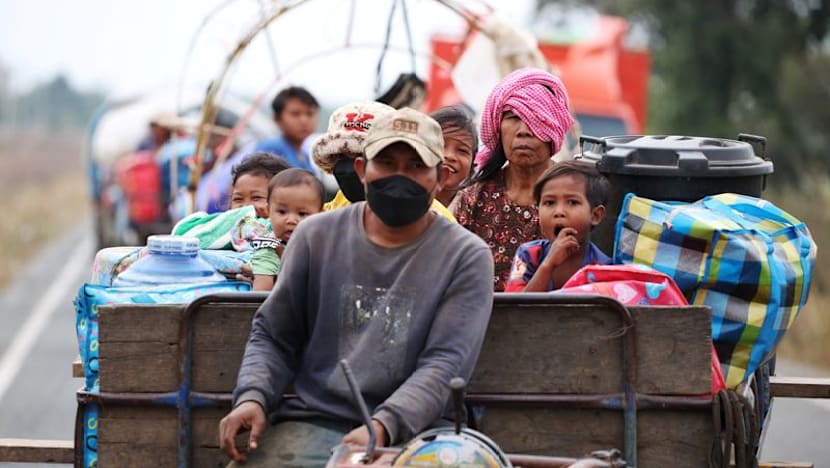
As nationalism on both sides gets more strident, any peace between Cambodia and Thailand engineered before the Feb 8 election will ultimately only be tactical, says former foreign correspondent Nirmal Ghosh.
New: You can now listen to articles. 
This audio is generated by an AI tool.

16 Dec 2025 06:00AM (Updated: 16 Dec 2025 08:31AM)
SINGAPORE: American President Donald Trump announced on Friday (Dec 12) that Thailand and Cambodia had agreed to a new ceasefire. That the fighting continued through the weekend is, in one respect, a lesson in the limits of the United States’ leverage.
The US has deep and long-running ties with Thailand. But national politics riding on rising nationalism, and an administration that sees this conflict as existential, can outweigh any influence even a powerful ally brings to bear.
Prime Minister Anutin Charnvirakul dissolved parliament on Friday, just over three months after he took power. Thailand is heading into an election on Feb 8, with a slight possibility of postponement on account of the conflict with Cambodia.
The conflict presents Mr Anutin, leader of the conservative Bhumjaithai Party, the chance to look tough and keep the powerful army on his side.
On this, he will have learnt from his predecessor Paetongtarn Shinawatra’s fall from grace: After seemingly kowtowing to Cambodia’s former leader Hun Sen and criticising one of her own senior army commanders over the border clash, she was dismissed by the conservative Constitutional Court in August.
SEEKING ADVANTAGE IN UPCOMING ELECTION
Border skirmishes then were hurriedly nipped in the bud by intervention from the Association of Southeast Asian Nations (ASEAN) and the United States, with Mr Trump claiming credit and overseeing a ceasefire agreement on the sidelines of the ASEAN summit in Kuala Lumpur on Oct 26.
But while that stopped the fighting, it did not alleviate the underlying issues of the countries’ historical rivalry overlayed by disputed post-colonial borders.
Moreover, Mr Anutin has been rocked by new challenges since. These include public dissatisfaction at his government’s slow response to devastating floods that killed more than 170 people in southern Thailand last month. He has also had to deny allegations of ties to the scam industry, in which elements of political and police elites in Thailand are seen as complicit or culpable.
As he manoeuvres for advantage in the upcoming election, and nationalism runs high, Mr Anutin may not choose to exercise restraint. The conflict – which each insists was provoked by the other – offers a useful way to reaffirm his credentials.
NO TEARS SHED OVER SCAM CENTRES?
It is possible the US understands this, and that it is not overly concerned about one significant aspect of the renewed fighting: Thailand’s targeting of scam centres in Cambodia.
A casino in Pursat province, belonging to Cambodian tycoon Try Pheap, was one of several bombed by Thailand in recent days. Try Pheap, who is close to Hun Sen, has been on the US Treasury sanctions list since 2019, for directly or indirectly engaging in “corruption, including the misappropriation of state assets, the expropriation of private assets for personal gain, corruption related to government contracts or the extraction of natural resources, or bribery”.
The US Treasury notice stated Try Pheap, who at the time owned or controlled 11 Cambodia-registered entities, had built a large-scale illegal consortium that “relies on the collusion of Cambodian officials, to include purchasing protection from the government, including military protection”.
It is safe to assume that no tears will be shed over the destruction of Try Pheap’s casino in Bangkok, Washington DC – or even Beijing. China, too, has been quietly urging Bangkok to take stronger action against the scam industry.
Thailand’s strikes on scam centres thus provoke little international backlash because the targets are already seen as criminal. But both US and China have to balance that imperative with the need to moderate the conflict before it deepens irretrievably.
NATIONALISM ON BOTH SIDES
For Thailand, strikes on scam centres kill two birds with one stone, as they also hit the financial networks of Cambodia’s elites. Thailand also claims the scam centres and casinos struck are being used as military facilities – which experts say is plausible.
Thailand’s generals apparently want to seize the opportunity to substantively degrade Cambodia’s military capabilities. Royal Thai Army Chief of Staff General Chaiyapruek Duangprapat told Thai PBS in an interview reported on Dec 14 that it will be “to a point that Cambodia will not pose a military threat to Thailand for a long time”.
Nationalism equally applies on the Cambodian side of the border, where Hun Sen and his son, Prime Minister Hun Manet, are also under pressure to prove they have what it takes to uphold Cambodian sovereignty.
They also have been taking pains to fend off accusations of elite complicity in Cambodia’s scam economy. According to studies, scam operations may generate the equivalent of half of Cambodia’s gross domestic product, which could not possibly operate at that scale without some form of support.

Cambodia has alleged that Thailand is hitting scam centres where Thais do not have investments, insinuating Thai complicity in the industry. But the conflict also gives Cambodia’s elites the opportunity to divert attention from the scam industry that has taken root and drawn international pressure.
GEOPOLITICAL TIGHTROPE
There are geopolitical angles as well to the conflict. Cambodia in recent years has become increasingly dependent on China, its top foreign investor and a key supplier of weaponry. But China has been upset by the scam industry preying on Chinese people – both in terms of trafficked labour and as victims.
Thailand, while close to the US, is adept at balancing ties. It was seen as increasingly accommodating to China under the military government led by General Prayut Chan-o-cha from 2014 to 2023. Thailand’s King Maha Vajiralongkorn in November became the first reigning Thai monarch to visit China.
“Action against these (scam) networks aligns with global norms rather than violating them,” said Pavin Chachavalpongpun, Professor at Kyoto University’s Centre for Southeast Asian Studies.
“Yet the move does more than fight crime,” he told me. “It disrupts transnational organised networks that overlap with elite financial interests, signals firmness to a China-leaning Cambodian leadership, and reassures the US that Thailand remains a useful security partner.”
Any peace engineered by the US, China or any other party, will ultimately be tactical.
It will not remove the long-simmering underlying causes of the conflict. Nationalism on both sides has only become more strident. Scam centres and the Cambodian elites’ financial networks have been severely dented but the industry is highly mobile and will disperse and continue.
There remain dangerous weeks ahead of Feb 8. “Nobody is in the mood for compromise,” a Thai politician – not from Bhumjaithai – told me. “If you compromise in the run-up to the election, you’ve had it.”
It is very probable that only after the election is settled, will there be any real chance to reset relations between the neighbours.
Nirmal Ghosh, a former foreign correspondent and US news bureau chief, is an author and independent writer based in Singapore.