
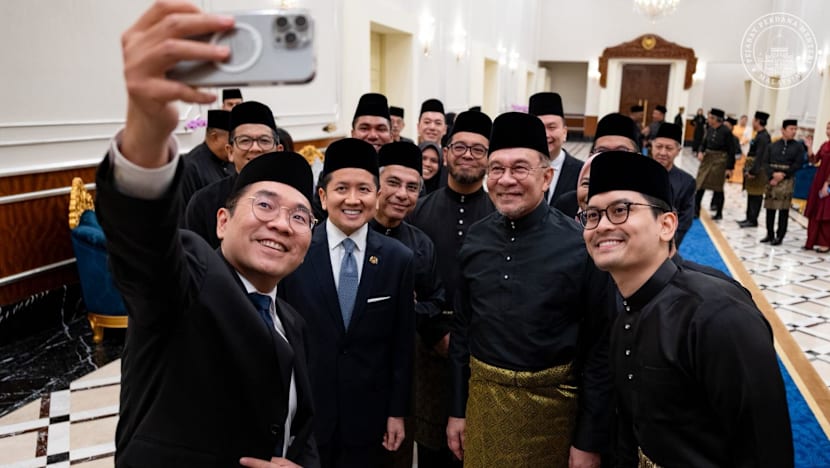
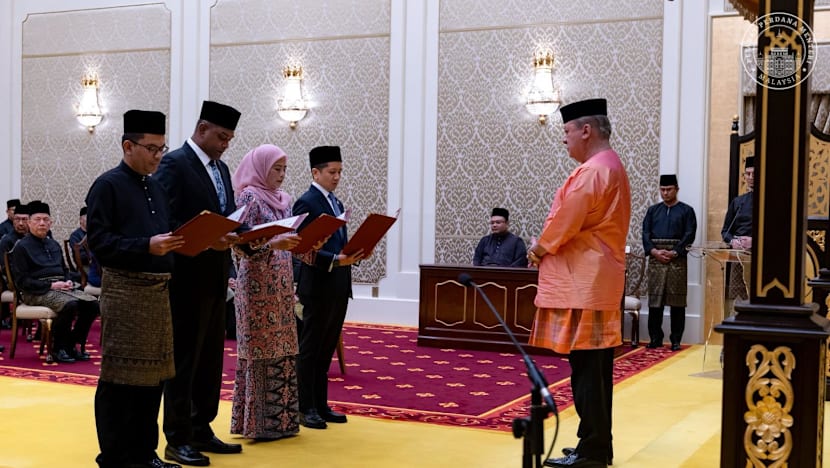
JOHOR BAHRU: Malaysian Prime Minister Anwar Ibrahim’s sweeping changes to his Cabinet line-up – with more than a third of the positions being altered – are designed to maintain a delicate balance of ministerial posts between the key component parties in his unity government, say analysts.
They add that the likes of United Malays National Organisation (UMNO) and the Democratic Action Party (DAP) are likely to be appeased with the changes since their ministerial quotas are maintained, setting the stage for a strong, unified government leadership ahead of the next general election (GE) due by February 2028.
Anwar’s Cabinet, which first took office after the 2022 GE, is made up of politicians from different parties that are part of different coalitions.
Each government component party is allocated a certain number of ministerial positions based loosely on the number of seats it has in the federal legislature.
While the exact quota for ministerial and deputy ministerial posts for each component party is not made public, analysts say Anwar has to ensure the allocation for the parties is maintained throughout the term of government.
The premier was also lauded by observers for making the “risky but brave” call to test the leadership of some of his own Parti Keadilan Rakyat (PKR)’s younger leaders, promoting deputy ministers Akmal Nasir, Taufiq Johari and Ramanan Ramakrishnan to full ministers, while axing the reportedly underperforming Federal Territories Minister Zaliha Mustafa from his Cabinet.
The changes announced on Tuesday (Dec 16) – which also included more Cabinet representatives from East Malaysia – are also seen as a nod to the underwhelming results for Anwar’s Pakatan Harapan (PH) coalition in the recent Sabah polls.
In the Nov 29 election, PH garnered only one seat, even though its allied party in the unity government Gabungan Rakyat Sabah (GRS) emerged with the largest number of seats.

Analysts had described the results as reflective of Sabahans’ overwhelming preference for Borneo-rooted politics and a rejection of political dominance from Peninsula parties.
Commenting on the overall Cabinet changes, political scientist Syaza Shukri of the International Islamic University Malaysia told CNA that while the number of positions altered is extensive, they are “not that substantive”.
“The changes are mostly switching positions, akin to playing musical chairs of leaders,” said Syaza.
“I think Anwar of course still needs to keep the status quo (of ministerial posts allocated to each component party) intact more or less. He needs to show confidence (in) his team,” she added.
The Madani unity government consists of the Pakatan Harapan coalition, Barisan Nasional (BN), GRS, and Gabungan Parti Sarawak (GPS).
PKR, DAP and Parti Amanah Negara are the key component parties in PH while UMNO is the biggest party in BN alongside smaller component parties like the Malaysian Chinese Association (MCA) and the Malaysian Indian Congress (MIC).
Following the latest reshuffle, of the 31 full ministries, PKR is helming nine positions, UMNO has seven, DAP has five, GPS has five, GRS has two while Amanah has two. The remaining post is helmed by Religious Affairs Minister Zulkifli Hasan.
ALL EYES ON TRADE, ECONOMY
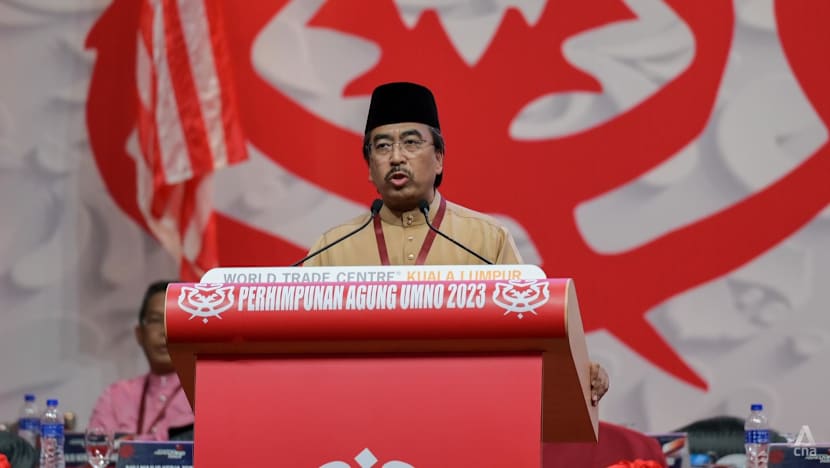
Analysts identified two appointments as key highlights of the changes – namely the selection of veteran UMNO leader Johari Ghani as the new Investment, Trade and Industry Minister and PKR’s Akmal as Economy Minister.
Johari, 61, was Minister of Plantation and Commodities and will take over the portfolio previously held by Tengku Zafrul Abdul Aziz, who had to step down earlier this month having served two three-year terms as senator – the maximum period allowed.
Azmi Hassan, a senior fellow at the Nusantara Academy for Strategic Research, told CNA that Johari was an “unsurprising pick” given his technocrat background and previous experience in key positions in government.
“He proved his worth even in a smaller portfolio in the plantations and commodities ministry, now it is time he is given a more important portfolio,” he added.
A trained accountant, Johari had previously served as Minister of Finance II under former premier Najib Razak.
He also sits on the board of directors for Malaysia’s sovereign wealth fund Khazanah Nasional and is on the Malaysia Economic Council. The council, chaired by Anwar, is responsible for formulating policies to boost Malaysia’s economic growth.
The trade ministry plays a key role amid an uncertain global trade environment, in which Malaysia has to manage its relationships with two global superpowers – US and China.
Syaza said that it was key that Anwar allocated this post to an UMNO candidate, given that Tengku Zafrul was an UMNO member when he was appointed to the role by Anwar after the 2022 GE.
Tengku Zafrul has since joined Anwar’s PKR. At the time of Tengku Zafrul’s resignation from UMNO in May, party president Ahmad Zahid Hamidi had said that “it is important” for UMNO to retain its full allocation of seven ministerial positions in the Cabinet.
“Johari Ghani’s name has always been in the mix when we talk about MITI (Ministry of Investment, Trade and Industry) and how it needs to go to UMNO and there’s really no other ‘technocrat’ best to take this on,” said Syaza.
Johari is also vice-president of UMNO, a key component party in Anwar’s unity government.
Analysts added that the appointment of the chief of UMNO women’s wing Noraini Ahmad to take over Johari’s post at the Plantation and Commodities Ministry would also appease the party.
Noraini, who previously served as Minister for Higher Education under Prime Minister Ismail Sabri Yaakob’s administration, was allocated only a deputy minister portfolio after the 2022 GE in the Women, Family and Community Development Ministry.
Azmi told CNA: “UMNO is a big winner (after the Cabinet changes) because they now hold MITI which is a major portfolio and Noraini, their chief of the women’s wing, is promoted to full minister.”
The appointment of Akmal, meanwhile, was more of a surprise, analysts said.
The 39-year-old was promoted to full minister in a key portfolio after his stints as deputy ministers in the Ministry of Energy Transition and Water Transformation and the Ministry of Development and Local Government.
Moreover, Akmal is seen as closely aligned to Rafizi Ramli, who resigned as Economy Minister after he was defeated by Anwar’s daughter Nurul Izzah in a contest to be the party’s deputy president in PKR’s internal polls in May.
The economy minister is a key portfolio as Akmal will be spearheading some of the Madani government’s subsidy rationalisation policies and better revenue collection under the 13th Malaysia Plan.
Since his resignation, Rafizi has been a vocal critic of Anwar’s government, calling out the premier’s administration for what he claims is a lack of action towards policy reforms and a perceived failure to pursue the anti-corruption agenda which PH campaigned on in previous GEs.
Syaza said that Akmal is an “interesting choice” as he is capable but also less likely to be critical of the government.
“Yes he’s a Rafizi ally but he’s also more of a team player within PKR. I think that’s why he’s chosen. He’s not likely to be vocal against the PM,” she added.
Azmi added that he did not see Akmal’s appointment as a sign of Anwar “consolidating power” in PKR.
“Rather it is a form of facilitating continuation given that Rafizi is his (Akmal’s) former mentor and he can seek counsel,” said Azmi.
Azmi also noted the appointment of Taufiq as Minister for Youth and Sports and PKR vice-president Ramanan as Minister for Human Resources as positive moves that could facilitate leadership renewal in Anwar’s party.
The two politicians – aged 29 and 44 respectively – are helming full ministerial posts for the first time.
Together with Akmal, the three leaders replaced PKR’s quota of Zaliha, Rafizi as well Nik Nazmi Nik Ahmad, who had resigned as the Natural Resources and Environmental Sustainability Minister in May after he lost his vice-president post in the party polls.
Meanwhile for PKR’s ally in PH – DAP – analysts said that the party can be satisfied with the reshuffling of its younger leaders to different portfolios.
The appointment of Hannah Yeoh from the Sports and Youth Ministry to Minister in the Prime Minister’s Department (Federal Territories) is seen as a positive move to give the 46-year-old more leadership exposure.
Political analyst James Chin, an Asian studies professor at the University of Tasmania, told CNA that moving Yeoh to a key portfolio was “fascinating”.
“She was doing a decent job in sports, so this reshuffling will (vary her) expertise,” Chin said.
Syaza said that Federal Territories was considered a “major portfolio” as it covers Kuala Lumpur – which is PH’s urban voter base.
“I think PH wants to reassure urban voters on what they can do,” said Syaza, adding that there was talk that Yeoh’s predecessor Zaliha was “not delivering” and is being seen as a “distant minister”.
EYE ON NEXT GE
Analysts said that the inclusion of three new politicians from Borneo was a move by Anwar to shore up support from Sabah and Sarawak following PH’s dismal showing in the recent Sabah polls.
The new additions to the Cabinet include two from Sarawak and one from Sabah.
They are PKR’s Miri Member of Parliament Chiew Choon Man as deputy minister for tourism, arts and culture, DAP’s Mas Gading MP Mordi Bimol as deputy youth and sports minister as well as GRS’ Tawau MP Lo Su Fui as deputy minister in the Prime Minister’s Department (Federal Territories).
“Major winners who have made big gains from the reshuffle were Sabah and Sarawak,” said Chin.
Analysts said that given this Cabinet reshuffle is likely to be the final round of major changes before the next GE, Anwar’s overall strategy is to maintain the status quo while taking calculated risks in testing out younger leaders by rotating their portfolios.
They added that ensuring no component party is disgruntled was pivotal, ahead of the parties jockeying for seats and possibly contesting under a unified umbrella against the Perikatan Nasional opposition coalition.
Azmi told CNA: “If the component parties in the Madani government are satisfied and can work together and avoid as far as possible multi-cornered fights, this can be a good strategy ahead of the next GE.”
Syaza added, however, that the Cabinet changes are unlikely to stem dissent from the MCA and MIC, as both have been omitted from any Cabinet appointments despite being in the unity government under the BN coalition with UMNO.
“I guess MIC and MCA would continue to be unhappy. But it didn’t help that they kept on criticising the government, which would dissuade the prime minister from bringing them into government,” she said.
Chin added that Anwar’s decision to replace the religious affairs minister – from senator Na’im Mokhtar to senator Zulkifli Hasan – was to appeal to the Malay Muslim electorate, since the former had been a lightning rod for criticism from the biggest opposition party Parti Islam Se-Malaysia (PAS).
“Na’im was not moving the needle in helping the Madani government recover support from the Malay voters and PAS is gaining strength, Anwar has to try to win back this support ahead of GE,” he said.
However, he maintained that the focus of the Madani government ahead of the next general polls should be to lean on its strengths, including boosting the economy rather than playing into the hands of the opposition by reacting to them playing on racial and religious sentiments.
“Overall the changes are minor, not major. It is only a reshuffle, he is not rocking the boat among his fellow allied parties,” said Chin.
“It is a GE Cabinet because of how close it is to the elections. Now we need to see if this government will deliver – it seems that Anwar’s (best bet) is to focus on strong economic policies since he is losing ground to PAS on issues like religion,” he added.