
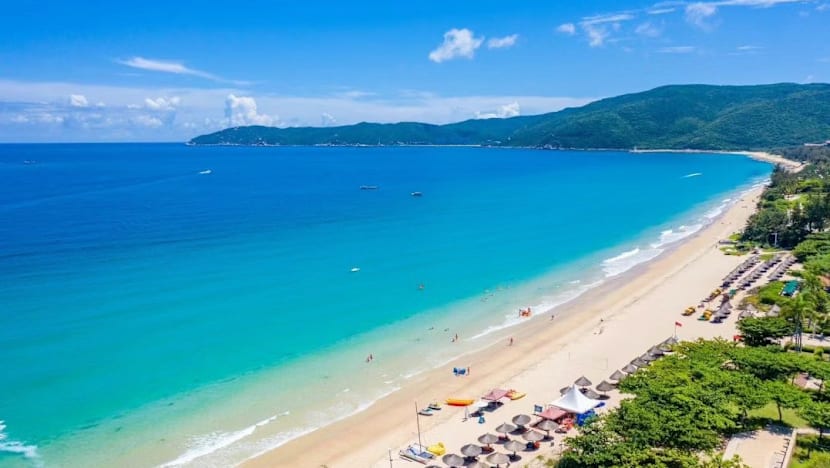
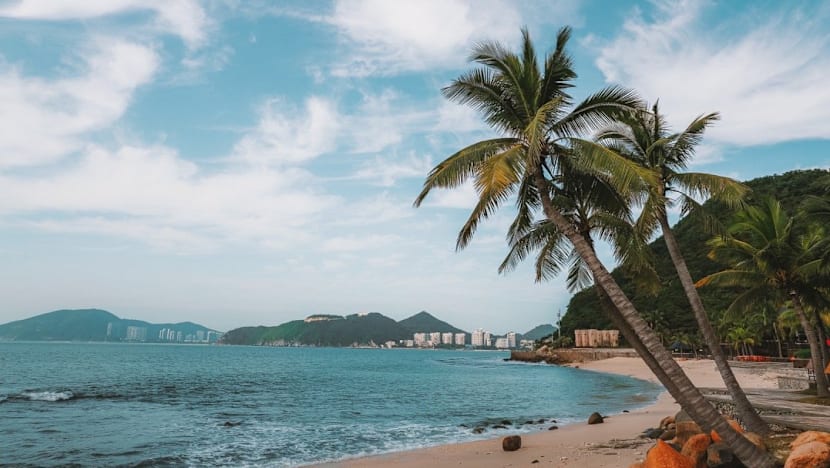
SHENZHEN: China’s only tropical island province, Hainan, is best known for its palm trees, beaches and as a winter refuge for retirees from the country’s north.
On Thursday (Dec 18), even as daily life went on uneventfully, change was in the air as the island of 10 million people formally became a distinct customs zone from the rest of China.
With broader zero-tariff access, lower taxes and a more business-friendly environment, analysts say Beijing is casting Hainan as a high-profile demonstration of its resolve to keep opening up amid global trade headwinds.
At the same time, China is using the island as a testing ground for deeper institutional opening, allowing policies to be trialled and fine-tuned before wider national roll-out, observers say.
“Hainan Free Trade Port is not designed to cushion all types of external shocks,” Wu Haili, an associate professor of practice in economics at Xi’an Jiaotong-Liverpool University, told CNA.
“Rather, it is meant to serve as a low-risk testing ground for China’s transition to higher-level openness.”
Even so, experts urge caution against over-reading the impact, saying the effectiveness of the model will hinge on factors such as regulatory coordination and Hainan’s ability to translate policy advantages into real economic activity.
A STRESS TEST FOR OPENNESS
China first announced plans to turn Hainan into a pilot free-trade zone in 2018. In 2020, that vision was elevated into a blueprint for a full-scale Hainan Free Trade Port, covering the entire province.
The move to carve the island out as a distinct customs regime was announced in July 2025, setting the stage for its Dec 18 launch.
Under the new rules, the share of goods eligible to enter Hainan tariff-free will go up to 74 per cent from 21 per cent, authorities have said, while the number of duty-free items will expand more than threefold to over 6,600.
Foreign companies can benefit from lower tax and production costs, and a business environment more closely aligned with international standards, while using Hainan as a launchpad to tap into the Chinese market, state news agency Xinhua reported.
Wu said the new customs regime may offer businesses a way to navigate tariff barriers.
Under the 2020 master plan, Hainan operates a “first-line open, second-line controlled” model. This means goods entering the island from overseas are treated as outside the mainland customs system, with standard customs controls applying only when they move into the mainland.
“The policy mix of the Hainan Free Trade Port may provide a feasible path to circumvent tariff barriers between China and the United States,” Wu said, adding that outcomes depend on business models, product categories and policy details.
The world’s two largest economies remain locked in prolonged trade tensions, marked by tariffs, export controls and growing uncertainty over supply chains.
Yet analysts said the Hainan Free Trade Port is less about cheaper imports than about testing deeper institutional opening, from freer flows of people, goods, capital and data to simpler trade procedures and lower operating costs.
Wu said that while China’s 20-odd free trade zones broadly serve similar purposes to boost trade, investment and financial openness, extending free trade policies across an entire province gives Hainan a distinct geographic edge.
“Hainan has the advantage of spatial isolation,” she said, referring to its island province status, geographically separate from the mainland.
“It facilitates a closed-loop operation … (which) makes it a testing ground for institutional opening-up.”
That setup, she added, allows Hainan to pilot reforms more boldly, helping China build experience that could later be applied at the national level.
Marco Sun, chief financial analyst at MUFG Bank China, similarly pointed out how Hainan’s circumstances are different from those of other free trade zones across China, which operate as fenced-in districts within cities and mainly serve trade transactions.
“By contrast, Hainan covers an entire province and is intended to be developed into a high-standard global free trade port with a regional reach into Southeast Asia,” he told CNA.
REGIONAL COOPERATION
Dong Ximiao, chief researcher at Merchants Union Consumer Finance, said Hainan’s role fits into Beijing’s broader push to better integrate trade and investment, as well as domestic and foreign commerce.
Positioned as “an important gateway leading China’s opening up in the new era”, Hainan’s accelerated development is intended to help diversify markets and deepen regional economic cooperation amid weakening external demand and heightened geopolitical tensions, Dong added.
In an indication of its importance, Hainan Free Trade Port was singled out for mention in China’s latest Central Economic Work Conference, which laid out policy priorities for the year ahead.
The meeting called for “solid progress” in developing Hainan Free Trade Port, while underscoring the need to “steadily advance institutional opening up”, Xinhua reported.
Dong noted that policymakers have also emphasised Hainan’s regional cooperation and the signing of more regional and bilateral trade and investment agreements.
“Through partnerships with 39 overseas free trade zones and ports, Hainan is positioned as a potential node linking markets along the Belt and Road Initiative (BRI)”, he said, referring to China’s flagship international economic cooperation strategy launched in 2013.
Chinese companies in Hainan have moved beyond a wait-and-see stance, with firms positioning themselves in advance of the island’s move to a distinct customs regime.
Data from Qichacha, a leading business information platform, shows that since the release of the Hainan Free Trade Port master plan in 2020, the island has registered over 1.2 million enterprises, nearly half of which are in wholesale and retail.
Willy Tan, founder of professional services firm ForBis, which advises companies on cross-border structuring and regional expansion, told CNA that “the mood is now one of urgency”, as firms increasingly adopt a “go global or go home” mindset.
“They view the (customs) seal-off not as a barrier, but as the ‘opening bell’ for Hainan to serve as their launchpad into Southeast Asia,” he added.
THE DUTY OF ADDING VALUE
One of the most closely watched policies under Hainan’s customs carve-out is the 30 per cent value-added rule, analysts told CNA.
Piloted in 2021, the rule allows goods processed on the island to enter the mainland duty-free if at least 30 per cent of their final value is created locally.
Hainan officials have said the policy is being expanded to encourage more processing, manufacturing and innovation on the island.
In a recent commentary on his Wechat official channel, business consultant Liu Run, founder of Runmi Consulting, wrote that the rule is designed to reward genuine processing rather than simple relabelling.
For instance, importing finished orange juice into Hainan duty-free, repackaging it and selling it to the mainland as a “Made in Hainan” product would not qualify for tariff exemptions, he said.
“But if raw oranges are imported and processed in Hainan through research and development – juicing, blending, formulation, design and packaging – the product’s value can rise from 10 yuan to more than 13 yuan,” Liu wrote.
“Once value added exceeds 30 per cent, it can be sold into the mainland tariff-free.”
Charoen Pokphand Group (CP Group) executive Xue Zengyi, whose Thailand-based conglomerate has invested about 20 billion yuan in Hainan across agriculture, aquaculture and coffee over nearly four decades, said that the move would create a more open trade environment and lower costs.
“After the (Hainan customs) seal-off, our coffee operations can benefit from the free trade port’s zero-tariff policy on raw materials, cutting import tariffs on green coffee beans by 8 per cent and value-added tax by 13 per cent,” he said at a Xinhua-hosted forum on Dec 17.
Xue noted that if the beans are processed in Hainan and the value added reaches or exceeds the threshold, the finished products can be sold into the mainland without import tariffs.
At their core, the new policies are meant to cut costs while ensuring companies carry out genuine processing and production on the island, rather than using Hainan purely for tax savings, analysts said.
Tan from ForBis said the group has been seeing member companies actively auditing their supply chains to ensure they are “Day 1 ready” to meet the value-added criteria.
However, Tan highlighted that some uncertainty remains.
“The main friction point is still the calculation methodology. Companies are raising questions about whether ‘value added’ includes intellectual property and R&D (research and development) costs, or limited strictly to physical processing costs,” he said.
A DUTY-FREE HAVEN TAKES SHAPE

For bargain hunters, the changes came earlier than Dec 18.
Updates to Hainan’s off-island duty-free shopping took effect on Nov 1, ahead of the new islandwide customs regime.
Official data shows the number of duty-free items has expanded from about 1,900 to around 6,600, with new categories including pet supplies, portable musical instruments, small home appliances and consumer electronics.
Rules for Hainan residents were also loosened. Those with at least one off-island trip in a calendar year can now purchase selected “buy-now, collect-immediately” items multiple times, as long as they stay within the 100,000 yuan (US$14,000) annual quota.
Eligibility has also been extended to outbound passengers, allowing international travellers to shop duty-free in Hainan before leaving China, rather than only at airports or tax-refund counters.
Officials said the upgrades build on the rapid growth of Hainan’s duty-free sector.
From 2020 to August 2025, cumulative sales reached 206.9 billion yuan – nearly four times the total recorded between 2011 and 2019 – with Hainan now accounting for more than 8 per cent of the global duty-free market.
Sun from MUFG Bank China said Hainan should also be viewed through the lens of China’s “domestic circulation” push – aimed at bolstering domestic demand and supply chains while reducing reliance on external markets.
He described the island as a testing ground for new consumption models, following earlier shifts from department-store retail to e-commerce that reshaped logistics, consumer protection and related services.
“If the Hainan model works, it could offer a template that other eligible cities may eventually learn from,” Sun said.
Collapse Expand
MOVING THE NEEDLE
Beyond the headlines, analysts urged caution in assessing the impact of Hainan’s customs carve-out, noting that outcomes will hinge on several factors.
Dong from Merchants Union Consumer Finance described regulatory capacity and coordination as the “lifeline” of ensuring the system is both open and well-regulated.
“The new customs model requires inspection and enforcement agencies, including customs authorities, to achieve information sharing, mutual recognition of supervision and coordinated law enforcement, placing high demands on cross-department data sharing,” he said.
He added that a predictable legal and business environment, as well as the ability to build a mature industrial ecosystem spanning supply chains, skilled labour and logistics, is equally important.
“The ultimate effectiveness of these policies will depend on whether Hainan can make real breakthroughs in regulatory efficiency, the rule of law and industrial ecosystem development, turning policy advantages into genuine development advantages,” Dong said.
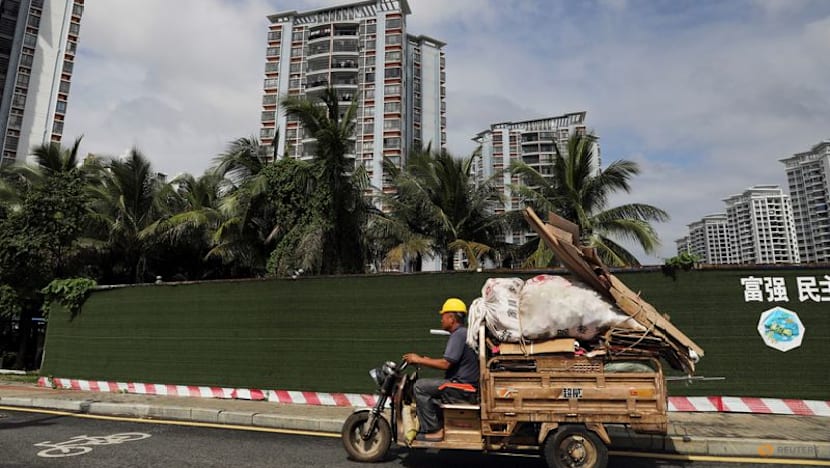
Sun from MUFG Bank China cautioned that the customs seal-off should be viewed as an institutional trial within China’s domestic circulation framework.
Using an analogy, he described the Hainan experiment as a beacon.
“I have noticed views suggesting that China’s consumption is entering a winter phase, or that the macroeconomic cycle is heading towards stagnation,” Sun said.
“The Hainan experiment can offer new evidence for assessing China’s actual trajectory. But a single light cannot solve all consumption-related problems – this is only a starting point.”