
Commentary
Perikatan Nasional is one of the longest-lasting coalitions for PAS, but the cracks are starting to show, says political analyst James Chai.
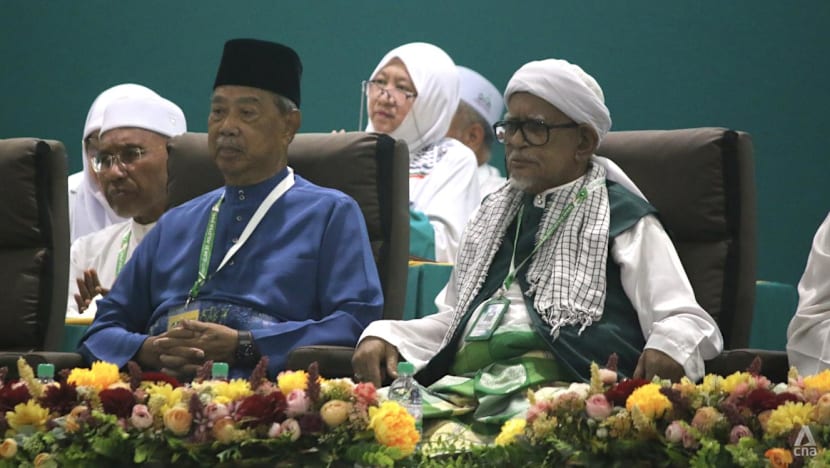
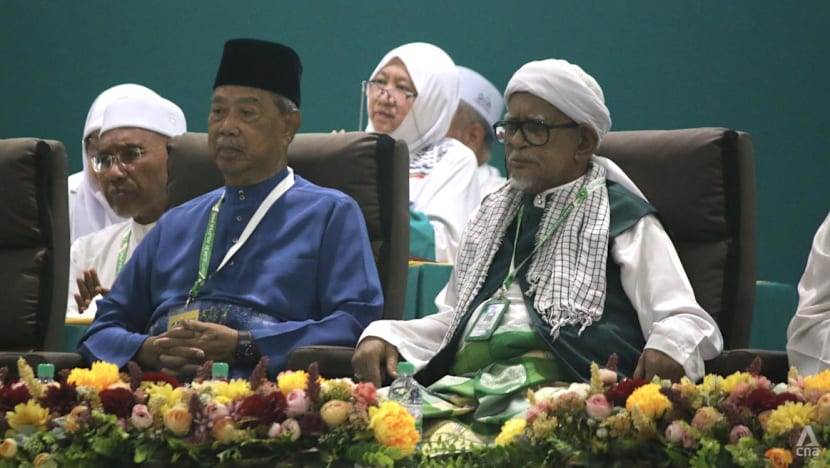
Parti Pribumi Bersatu Malaysia president Muhyiddin Yassin (left) and Parti Islam Se-Malaysia president Abdul Hadi Awang at the latter’s annual general meeting on Sep 15, 2025. (Photo: CNA/Aqil Haziq Mahmud)
New: You can now listen to articles. 
This audio is generated by an AI tool.

09 Jan 2026 06:00AM (Updated: 09 Jan 2026 08:19AM)
KUALA LUMPUR: No one would have expected a conflict in Malaysia’s smallest legislative state assembly, Perlis, to become a flashpoint for the opposition coalition’s deepest rift. In the 2022 state election, the Perikatan Nasional (PN) coalition, consisting of the religious conservative Parti Islam Se-Malaysia (PAS) and indigenous-Malay-focused party Bersatu, won all but one seat.
Yet, a crack in its stronghold has rattled all the way to the top: Bersatu chairman and former Prime Minister Muhyiddin Yassin resigned as PN chairman on Jan 1 amid a series of other high-profile Bersatu resignations. PAS president Abdul Hadi Awang said last week that his party was ready to take over as chair of the opposition coalition.
Things started unravelling at the end of December, when eight state assemblymen (five Bersatu and three PAS) withdrew their support for the PAS chief minister, resulting in the chief minister losing the confidence of the majority. PAS sacked the three state assemblymen involved and urged Bersatu to do the same – the latter did not.
Shortly after a Bersatu chief minister was appointed in place, PAS leaders made cryptic social media posts about backstabbing and “betrayal [that] must not go unpunished”. The party also said it would not be part of the new state executive council.
Such a split is more consequential now as 2026 is widely treated as an election preparation year. Politicians will aim to use the series of state elections as a testing ground for the general election that must be called by 2028 but could be as early as this year or next.
The coalition choices that PAS and Bersatu make will directly affect their winning chances. A divided opposition is a weaker election opponent.
SIMMERING TENSIONS
It has been obvious since 2022 that PAS does not believe that Bersatu brings anything valuable to the table. PAS’ four-state governance council (SG4) marginalised Bersatu from the start, indicating that the latter does not feature in the former’s long-term plans.
When Bersatu’s renegade members switched sides to support the unity government in 2023, PAS made no attempts to defend them. Bersatu also no longer brings financial support to the coalition since its accounts were frozen and seized in 2023 in a corruption probe. PAS likely no longer thinks such support is essential, especially after making electoral breakthroughs in unexpected places like Sabah without Bersatu’s funding.
The leadership tussle within Bersatu, aimed at removing its prime ministerial candidate, Mr Muhyiddin, has weakened Bersatu’s appeal, at a time when PAS is seriously considering its candidates as capable of being national figures.
PAS is, after all, the largest party in parliament with 43 seats, whereas Bersatu only has slightly more than half (24 seats), of which four were won under the PAS flag. It would be easy for PAS to assume that Bersatu is the one profiting from the coalition.
LOOKING FOR NEXT COALITION PARTNER?
Not that PAS has a good coalition track record either. In its 75-year history, it has been part of at least 10 coalitions, without lasting more than five years on average. It has worked with almost all the mainstream political parties, including the United Malays National Organisation (UMNO) and Parti Keadilan Rakyat (PKR).
Its current coalition, PN, is already one of the longest-lasting. It is reasonable to assume that on its sixth-year mark, cracks will show. When that happens, PAS will once again be finding another partner.
This time, PAS senior party leaders are reviving the old dream of partnering with the oldest Malay party, UMNO, once more as part of the Muafakat Nasional accord. UMNO’s youth chief has celebrated this idea, though its highest leadership have given no signals thus far.
Notwithstanding how short-lived the last accord was (barely a year), this green-and-red concept is attractive to both parties. It plays to a highly emotive sentiment among Malay voters of “uniting the ummah”. A partnership that could unite the two largest Malay-Muslim parties could also unite the Malay-Muslim population and its destiny.
The only problem, of course, is that this is highly impractical for the fundamental reason that PAS and UMNO compete for the same Malay-majority seats. At the same time, both party leaders do not intend to share the leadership position with the other; both parties also believe that they are on the ascend and would one day seek to dominate the rest.
PAS and UMNO both have grounds to believe these, even though both realities cannot be true at the same time. To some extent, both parties know this. That is why they have never formalised a coalition beyond high-level narrative cooperation.
SHORING UP THE NARRATIVE
That said, such a possibility should not be ruled out, because both parties need positive news to distract from bigger issues now.
After the second conviction of former leader Najib Razak in the largest 1MDB-related trial, UMNO can no longer sidestep the wishes of its grassroots to leave the unity government. As the general election approaches, with a series of state elections preceding it, UMNO will also benefit from an indigenous Malay-Muslim narrative to distance itself from Prime Minister Anwar Ibrahim’s coalition, especially after its poor Sabah results.
Whether or not UMNO leaves the government is less material to its ability to shore up narrative support among Malay voters.
For PAS, moving closer to UMNO now is opportunistic after Mr Muhyiddin and his senior leaders have resigned from their coalition positions. While PAS could install its leaders, they know there is an inherent risk of national rejection without the backing of a more moderate Malay party. At the same time, even if the Muafakat Nasional accord does not turn into a formal coalition for elections, showing Bersatu that it has options is good for PAS.
Ultimately, UMNO and PAS are fairweather friends who are willing to work with each other as long as the partnership is not serious. Contesting an election together will likely generate animosity and intense quarrelling.
Both will likely have more advantageous outcomes if they were to stay where they are. But as the 16th General Election looms, every party is looking for any advantage it can get.
James Chai is a Visiting Fellow at ISEAS-Yusof Ishak Institute, with a newsletter on global affairs. He writes a monthly column for CNA, published every second Friday.
Comments are closed.