Commentary: ASEAN must hold the line on Five-Point Consensus for Myanmar’s reintegration
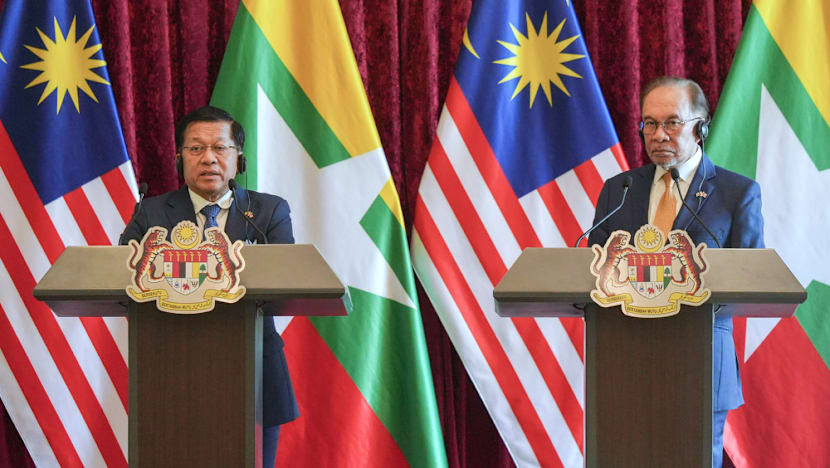
Myanmar’s political reintegration into the Southeast Asian bloc should follow demonstrable progress, not be offered in the hope that progress will follow, says Joanne Lin from the ISEAS-Yusof Ishak Institute.
Myanmar's President Min Aung Hlaing, left, speaks as Malaysia's Prime Minister Anwar Ibrahim listens during a joint press conference following their meeting in Putrajaya, Malaysia, Thursday, Oct. 8, 2026. (AP Photo/Azneal Ishak, Pool)
This audio is generated by an AI tool.
SINGAPORE: Malaysian Prime Minister Anwar Ibrahim received Myanmar leader Min Aung Hlaing in Kuala Lumpur in October and said Malaysia would work toward Myanmar’s “full reintegration” into the Association of Southeast Asian Nations (ASEAN). His remarks sharpened a question the 11-member grouping can no longer avoid.
Since April, Min Aung Hlaing has been received by Laos, Thailand, Cambodia, Vietnam and Malaysia. Myanmar’s bilateral relations with a growing number of ASEAN members are becoming more normal, even as its political representation at ASEAN summits and meetings remains restricted.
ASEAN will not be able to reverse these contacts. Engagement with Naypyidaw is necessary for practical reasons and is also part of any attempt to implement ASEAN’s Five-Point Consensus (5PC), the peace plan agreed after the 2021 military coup.
However, the grouping needs to distinguish between engagement, bilateral normalisation and collective reintegration.
Guess Word Crack the word, one row at a time

Buzzword Create words using the given letters

Mini Sudoku Tiny puzzle, mighty brain teaser

Mini Crossword Small grid, big challenge

Word Search Spot as many words as you can

Related:

ASEAN’S COLLECTIVE DECISION
That distinction is not always easy to draw. ASEAN members have their own economic and political reasons for maintaining functioning bilateral ties.
Thailand needs channels to manage a long border, refugees, migrant labour, trade and transnational crime. Malaysia needs cooperation on repatriations, having sent back more than 10,000 Myanmar nationals so far amid concerns that refugees had become a financial burden and security risk.
Practical necessity can justify engagement. Engagement does not in itself amount to normalisation, but repeated high-level contacts and state-level treatment can gradually contribute to it.
But bilateral engagement cannot determine Myanmar’s political standing in ASEAN. That remains a collective decision.
Myanmar appears to be using warmer bilateral ties to gradually rebuild its regional standing, even as it pushes back against the 5PC.
Its new ASEAN Affairs Committee, which held its first meeting on Oct 13, has been tasked with restoring Myanmar’s “original role and rights” in ASEAN while building on bilateral relations with individual member states. At the same time, Min Aung Hlaing has criticised the 5PC, Myanmar’s parliament has pushed back against it, and Naypyidaw has questioned the continued need for an ASEAN Special Envoy.
As more ASEAN members treat Naypyidaw as an ordinary political counterpart, the grouping may find it more difficult to maintain its collective restrictions.
WHAT COUNTS AS PROGRESS?
Against this backdrop, the 5PC remains important even if progress on implementing it has been limited.
The point is not to expect all five elements to be fully achieved before ASEAN can move forward, but to retain a common benchmark against which progress can be assessed. As Singapore Foreign Minister Vivian Balakrishnan put it, the 5PC “was and remains valid”, but ASEAN needs to see “demonstrable progress”.
The more difficult question is what demonstrable progress looks like. He identified three areas: an end to violence against civilians, the release of political detainees including ex-leader Aung San Suu Kyi, and humanitarian assistance reaching people across the country regardless of political allegiance.
These need to be translated into outcomes that can realistically be observed.
A literal cessation of violence across Myanmar is not a realistic short-term expectation. The conflict involves the military, ethnic armed organisations, People’s Defence Forces and other armed groups operating in a highly fragmented environment.
If cessation of violence is not yet realistic, civilian protection could serve as a more practical benchmark.
The question should be whether harm to civilians is decreasing, whether humanitarian pauses or local ceasefires are observed, and whether all forces show greater restraint. This should apply to all armed actors, although the military’s control of air power and the state's coercive machinery give it particular responsibilities.
ASEAN's Five-Point Consensus
Following a 2021 military coup, ASEAN has excluded Myanmar from high-level meetings as it has yet to make meaningful progress on the bloc's Five-Point Consensus to end hostilities.
During a meeting in April 2021, all ASEAN leaders reached a consensus about the situation in Myanmar.
The five points are:
First, there shall be immediate cessation of violence in Myanmar and all parties shall exercise utmost restraint.
Second, constructive dialogue among all parties concerned shall commence to seek a peaceful solution in the interests of the people.
Third, a special envoy of the ASEAN chair shall facilitate mediation of the dialogue process, with the assistance of the secretary-general of ASEAN.
Fourth, ASEAN shall provide humanitarian assistance through the AHA Centre.
Fifth, the special envoy and delegation shall visit Myanmar to meet with all parties concerned.
Humanitarian access may be easier to assess. Can the ASEAN Coordinating Centre for Humanitarian Assistance on Disaster Management (AHA Centre) and other credible humanitarian actors reach communities beyond areas controlled by Naypyidaw? Can assistance cross territorial lines without political discrimination?
Progress on political detainees can likewise be measured through releases, access to detainees and whether politically motivated arrests continue.
A REALISTIC ROLE FOR ASEAN
This can help ASEAN assess whether engagement is producing tangible changes on the ground. Helping to bring about those changes is more challenging.
ASEAN has limited leverage to bring Myanmar’s warring parties to the negotiating table. The bloc cannot compel them to negotiate or enforce a settlement, and its access depends largely on their readiness to cooperate.
Broad dialogue remains difficult even with the creation of the Steering Council for the Emergence of a Federal Democratic Union. While it brings together the National Unity Government – Myanmar’s parallel civilian government formed after the 2021 coup – and several important ethnic and resistance organisations, Myanmar’s opposition remains fragmented, with other powerful armed groups pursuing their own interests and controlling different territories.
Naypyidaw also continues to reject some of these actors as legitimate interlocutors, while mistrust among the parties remains deep.
A more realistic role for ASEAN is to maintain channels with different actors and gradually create space for dialogue where possible.
The rotating Special Envoy system also needs attention. Philippine Foreign Secretary Maria Theresa Lazaro has acknowledged that changing the envoy every year is not especially effective because each Chair has to rebuild relationships and situational knowledge.
ASEAN foreign ministers have discussed a longer-term envoy, as well as a benchmarking mechanism for the 5PC. Both would help ASEAN maintain greater continuity and assess progress more consistently despite limitations.
ASEAN should also avoid treating Myanmar’s post-election institutions as evidence of substantive political change. A recent paper by the ISEAS-Yusof Ishak Institute suggests that power has largely been reorganised around Min Aung Hlaing, with effective authority still concentrated in military-linked structures.
Political reintegration should depend on changes in behaviour and political conditions and not simply on new constitutional forms.
Related:
A TEST FOR NEXT ASEAN CHAIR
All of this will land on Singapore next year as it assumes chairmanship in ASEAN’s 60th year.
It will also be the 50th anniversaries of ASEAN’s dialogue relations with the United States, European Union and Canada, making the optics of Myanmar’s political reintegration particularly sensitive.
Myanmar may become one of the earliest tests of ASEAN’s credibility under its chairmanship. ASEAN countries will continue to decide for themselves how far to engage Naypyidaw bilaterally.
Singapore’s task as Chair is not to manage those relationships, but to keep them separate from ASEAN’s collective decision on Myanmar’s political representation. ASEAN will not want to keep Myanmar out indefinitely, nor should engagement with Naypyidaw stop.
But Myanmar’s political reintegration into ASEAN should follow demonstrable progress and not be offered in the hope that progress will follow.
Joanne Lin is a Senior Fellow and Coordinator of the ASEAN Studies Centre at ISEAS - Yusof Ishak Institute. She is also a Fulbright Visiting Scholar at the MIT Center for International Studies.
Source: Read original story


Comments ()