Climate change is altering the colors we see in the world: an illustrated journey
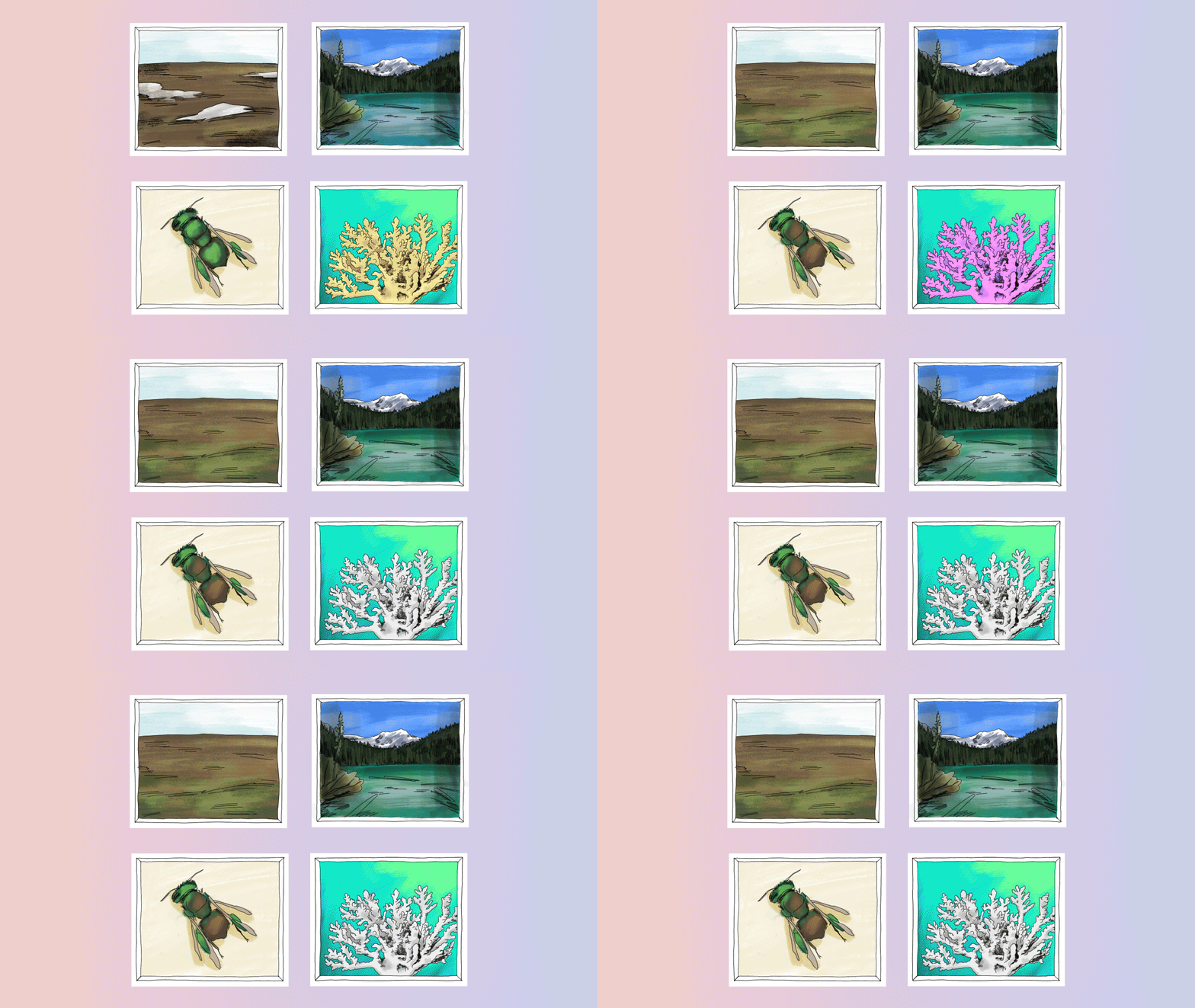
Imagine the bright tones of coral under the sea. What do you see? What colors come to mind?


One of the ways that climate change will alter — or has already altered — our world is by shifting the familiar colors of nature. When warming ocean waters bleach the vibrant colors of coral to white, that’s one example.

“Many young scientists who are working on coral reefs don’t realize that what they’re seeing is vastly degraded,” says Anya Salih, a scientist who has studied coral reefs and their fluorescent colors for decades. “It’s often hard to perceive how it was to what it is now.”
This change of color isn’t just aesthetic. For coral, bleaching leaves them vulnerable to disease and other stressors that can lead to death. In other situations, these color changes have more complex impacts, ones that scientists are still trying to understand.


How climate change transforms the colors of our world
An illustrated journey
Published Nov. 8, 2026

A shifting landscape in the Arctic
Every summer, massive climate-driven wildfires spread soot across huge swaths of the Arctic, covering the ice in a blanket of black particles. Soot pollution from oil and gas operations, as well as commercial shipping and increased tourism, contributes to the problem at both poles.
The dark particles coat white snow and soak up heat from the sun, exacerbating melting that was already happening more quickly because of climate change. Increased melting in the Arctic leads to sea level rise, which threatens communities across the world. And the soot itself pollutes the air and water it seeps into.
“We know that the high northern latitudes are warming faster than the rest of the planet,” says Douglas Morton, an Earth scientist at NASA’s Goddard Space Flight Center. These changes are shifting the colors of the Arctic landscape.
The Arctic is warming faster than the rest of the planet
Annual surface air temperature, departure from the 1991-2020 mean
Beyond the Arctic ice at the pole, farther south, lie vast regions of permafrost: soil that has remained frozen for years.

But the warming climate is causing permafrost to thaw.
And in some places, crack and collapse.
As permafrost thaws deeper into the soil, nutrients become more available and plants can grow deeper roots. These conditions can stimulate plant growth and enable larger vegetation like trees to gain a foothold, turning the landscape greener.
These established plants also trap snow in the winter, insulating the plants from the cold and promoting further plant growth.

But the warming climate is causing permafrost to thaw.
And in some places, crack and collapse.
As permafrost thaws deeper into the soil, nutrients become more available and plants can grow deeper roots.
These conditions can stimulate plant growth and enable larger vegetation like trees to gain a foothold, turning the landscape greener.
These established plants also trap snow in the winter, insulating the plants from the cold and promoting further plant growth.
A 2020 study in Nature Communications used satellite data to estimate Arctic vegetation over time, sampling thousands of sites across Alaska, Canada and western Eurasia. The researchers found that between 1985 and 2016, about 38% of the sites showed greening.
“Not everywhere in the Arctic is green,” says Logan Berner, a terrestrial ecologist with the University of Alaska Southeast, who led the study. “But there’s enough greening that if you look at the average greenness of the Arctic over time, it’s going up.”
According to Berner, who grew up in southern Alaska, this consistent increase in average greenness tracks strongly with an increase in summer temperatures.
The Arctic is becoming greener
Scientists measuring annual peak greenness have found that the Arctic has overall become greener since 2000. Greener locations are areas where plants increased over time, becoming taller, denser or healthier. Some locations have become less green due to extreme weather and wildfires.

Annual rate of greening, 2000-2025
Less green
More green
Pacific Ocean
Arctic
Circle
Arctic
Ocean
60° North
Atlantic Ocean

Annual rate of greening, 2000-2025
Less green
More green
Pacific Ocean
Arctic
Circle
Arctic
Ocean
60° North
Atlantic Ocean

Annual rate of greening, 2000-2025
Less green
More green
Pacific Ocean
Arctic
Circle
Arctic
Ocean
60° North
Atlantic Ocean
Source: NOAA’s Arctic Report Card 2025
Though the Arctic might seem far away from us, Berner notes that it’s a “bellwether for the kinds of impacts that climate change can have.” And increased greening can negatively impact the people who live in the Arctic and rely on its natural resources. For example, as shrubs expand across northern lands, they can shade out berry patches that people rely on for food; changing weather patterns can also affect the timing of fruit and its quality.

Changes in our water
“People have coined the term that lakes are sentinels in the landscape,” says David Butman, a professor at the University of Washington who focuses on biogeochemistry and satellite remote sensing. Lakes react quickly to changes in the environment, so measuring lake color through satellite monitoring can help quantify those changes.
Butman worked on a 2021 study in Proceedings of the National Academy of Sciences of the United States of America (PNAS) that measured green wavelengths in more than 400,000 lakes in the boreal Arctic zone in North America. Researchers found that green values declined by 15% between 1984 and 2019, meaning that, to the naked eye, these lakes got significantly darker.
Thawing permafrost is a possible reason. As it thaws, soil can mix with lake water, making it darker. The researchers found that the greatest declines happened in warmer and wetter regions.
The darker a lake gets, the more heat it can store, according to Butman. “You can imagine, you know, a black car and a hot day,” he says. The darker a lake is, the longer it stays warm after the summer, disrupting the natural timings of processes like fish life cycles and algae production. When soil or other outside material sinks to the bottom of a lake, microbes consume oxygen to break it down, leading to the production of methane, a potent planet-heating gas.
On a global scale, many lakes fall within the green-blue color spectrum. Bright blue lakes, often depicted in illustrations, are rarer than green lakes.
In 2022, scientists Xiao Yang and Catherine O’Reilly led a study in Geophysical Research Letters that analyzed the color of more than 85,000 lakes. They found that blue lakes are generally found in northern places with cooler summers and are covered in ice in the winter, such as Moraine Lake in Canada or Lake Baikal in Russia.

Globally, approximately 31% of the Earth’s lakes are blue.


Yang and O’Reilly predict that fewer blue lakes will exist as summers get warmer and winter ice cover decreases due to climate change.

The birds and the bees
Many animals have appearances that blend in with their surroundings for survival. When those surroundings start to shift, animals such as the snowshoe hare begin to stand out. The snowshoe hare’s white winter fur sticks out with less snow on the ground, leaving it more vulnerable to predators.

Researchers haven’t found evidence that hares are adapting the timing of their molts to align with their changing winter. But some insects have already changed coloring. North American male dragonflies, for instance, have adapted to warmer climates by losing color on their wings, according to a study in PNAS.

Losing some of the heat-absorbing color can help the dragonflies stay cooler, but the males also lose color that helps attract females. And researchers predict this will continue to be the case in the future as the climate continues to warm. An even tinier example is a specific kind of bee.
Sevan Suni is an associate professor at the University of San Francisco who studies interactions between plants and pollinators. She has been going to Costa Rica for the last 15 years to study a group of bees commonly known as orchid bees.
These bees are the sole pollinators for about 200 species of orchids in Central and South America. Their bodies look almost jewel-like, with shiny iridescent shells.
Year after year, Suni noticed that one species of bee, the champion’s orchid bee, seemed to shift color from blue-green to orange-red. She and others discovered that, in hotter areas, the number of orange-red bees has increased over time while the number of blue-green bees has decreased.

The areas that increased in temperature faster over time also had more of the red-orange bees. It’s unclear what’s driving this change. The darker blue-green color could be hotter, absorbing more heat. Or the blue-green bees may be more vulnerable since the color of their environment is changing. Due to deforestation in Costa Rica, they may be less camouflaged in a less green environment. Either way, Suni has concerns about potential impacts.
“As a biologist, I’m always interested in biological variation,” she says. “It worries me a little bit if the blue-green morph has an important ecological function and they’re getting less prevalent over time.”

A last gasp of hidden color
Warming ocean waters bleach colorful corals, turning them white. The corals expel symbiotic algae, losing a food source and becoming more vulnerable to disease. Corals can recover after bleaching, but the longer and more frequent the bleaching, the more difficult recovery is. In some cases, corals turn stunningly fluorescent and colorful at the start of bleaching and after — a last bright gasp of life.
These neon colors, usually visible only under ultraviolet light, are always present to some degree, says Anya Salih. Salih, a fellow at the University of Technology Sydney, has studied coral reefs and their fluorescent colors for decades. She dives at night to scan reefs with blue lights.
“Sometimes when I dive with people who are not used to seeing this, I would have to hold their tank so that they don’t turn upside down,” she says, “because in that very colorful, psychedelic world, you lose the perspective of up and down in the water.”
Algae in healthy coral absorb sunlight for energy. When the algae leave due to stress, turning the coral white, more light travels through the remaining skeleton.
How does a coral bleach?

1.
3.
2.
The coral becomes white and bleaches, making it more vulnerable to disease and death. Sometimes the coral turns colorfully fluorescent before bleaching.
A healthy coral and algae depend on each other. The coral provides the algae a place to live, and the algae provide the coral with its main sources of nutrients and color.
If stressed, often because of higher ocean temperatures, algae leave the coral.

3.
1.
2.
The coral becomes white and bleaches, making it more vulnerable to disease and death. Sometimes the coral turns colorfully fluorescent before bleaching.
A healthy coral and algae depend on each other. The coral provides the algae a place to live, and the algae provide the coral with its main sources of nutrients and color.
If stressed, often because of higher ocean temperatures, algae leave the coral.

1.
A healthy coral and algae depend on each other. The coral provides the algae a place to live, and the algae provide the coral with its main sources of nutrients and color.
2.
If stressed, often because of higher ocean temperatures, algae leave the coral.
3.
The coral becomes white and bleaches, making it more vulnerable to disease and death. Sometimes the coral turns colorfully fluorescent before bleaching.
A 2020 study in Current Biology found that this excess light encourages coral to produce the shockingly colorful pigments. This tends to occur when heat stress is mild and coral cells can still function. These colorful pigments act as a kind of sunscreen barrier protecting the coral from light damage, which encourages algae to return. Researchers believe corals that bleach colorfully have a higher chance of recovery.
Salih has seen reefs glow, bleach and recover, even multiple times. Still, climate change is causing ocean temperatures to rise, creating more bleaching. “So the scope for recovery is low,” she says.
In the past year, how many coral reefs have experienced bleaching-level heat stress?
Percentage of 5-kilometer ocean grids with reefs that have experienced bleaching-level heat stress during a rolling 365-day period
Coral bleaching has ripple effects on the larger ecosystem of the reef. A 2022 study in Global Change Biology found, for instance, that fewer fish with colorful bodies were found in the Great Barrier Reef following a specific bleaching event. In the future, reef ecosystems might be less diverse, bright and colorful.
“The neon glows of the reefs are a stress response. It’s a cry for help,” says Salih. “They’re fighting for their survival. They’re using their colors to protect themselves. But in many ways they’re failing in many parts of the world. And the reefs are collapsing.”

Now imagine a glacial lake. A pristine ice sheet at the North Pole. Or the vibrant shades of coral.
What do you see now?
Color can be a fleeting, subjective thing, simply how one perceives light reflecting off a surface. But it’s also how we see and know our world, and our world is slowly changing around us, even if we don’t notice.

Salih remembers when she accompanied a group of scientists to an Australian reef. “I was also recently on that reef, which was dying, pretty much,” she says. “And they’d never been on the reef and they thought it was beautiful.”
Source: Read original story



Comments ()