
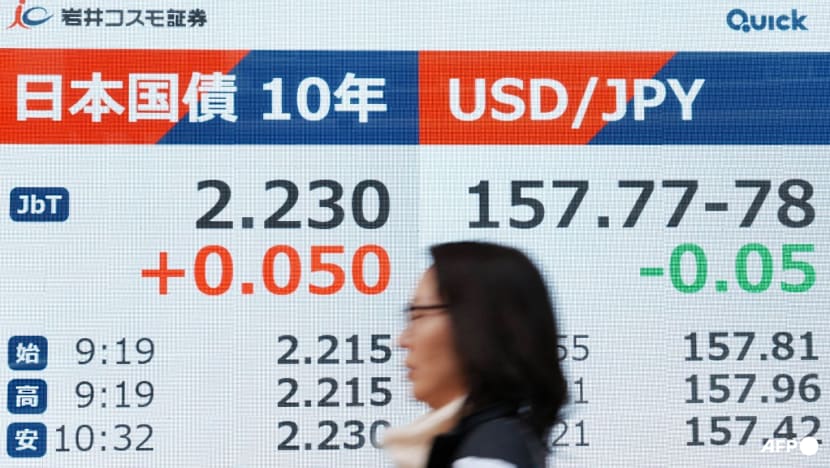
Analysts say the dollar’s recent weakness reflects broader concerns about Washington’s policy direction and investor confidence in US assets.
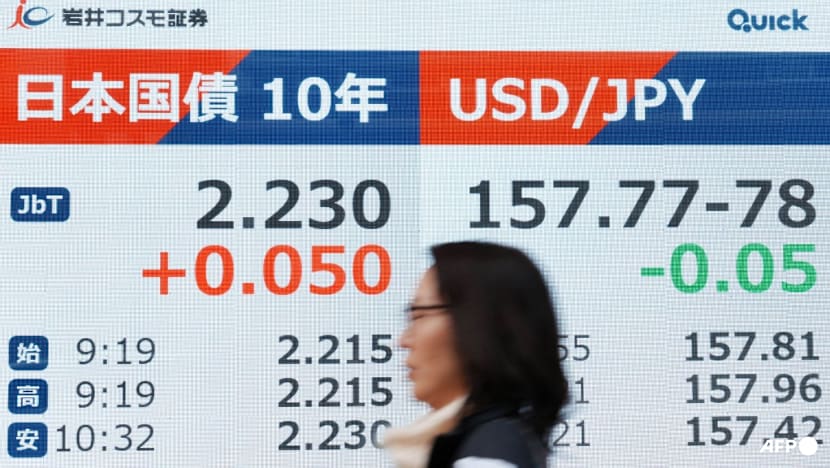
A woman walks past electronic quotation boards displaying 10-year government bonds and the foreign exchange rate of Japanese yen against the US dollar in Tokyo on Jan 19, 2026. (Photo: AFP/Kazuhiro NOGI)
New: You can now listen to articles. 
This audio is generated by an AI tool.

28 Jan 2026 12:22PM (Updated: 28 Jan 2026 02:29PM)
SINGAPORE: Speculation that American and Japanese officials could move to support the yen weighed on the US dollar on Monday (Jan 26), triggering broad moves across Asian currencies.
Reports that the Federal Reserve Bank of New York had checked in with traders about the yen’s exchange rate pushed the Japanese currency to its strongest level against the greenback since November.
But analysts say the yen was only part of the story behind the dollar’s recent weakness, as broader concerns about US policy direction and demand for US assets also play a role.
US President Donald Trump’s comments on Tuesday, brushing off the dollar’s decline, sent the greenback to a four-year low against a basket of currencies.
CNA explains what’s going on.
What’s going on with the yen?
The yen has been relatively weak compared with other major currencies, particularly towards the end of 2025 when Prime Minister Sanae Takaichi took office, said Mr Sim Moh Siong, a currency strategist at Bank of Singapore.
Takaichi has been advocating big government spending to boost economic growth. In December, Japan’s government approved a record 122.3 trillion yen budget, which includes higher defence spending and measures to tackle ballooning social security costs.
There are concerns that such fiscal expansion could place pressure on Japan’s central bank to keep interest rates low to support government spending, Mr Sim explained.
Lower interest rates tend to weaken a currency by offering lower yields for investors, making the currency less attractive and reducing demand for it.
These fiscal and political concerns have distorted the yen’s usual relationship with the US dollar, Mr Sim said. Historically, the yen would strengthen when US interest rates fell relative to Japan’s.
“But despite the US interest rates falling relative to Japanese interest rates, the yen has been weak,” he noted.
That weakness has become problematic for Japanese politicians ahead of the Feb 8 elections.
“A weak yen is politically unpopular given that it is seen as contributing to rising inflation … or rising costs of living in Japan,” Mr Sim said.
“As a result, … politicians have stepped up efforts to prevent the yen from weakening. At first, we saw more verbal intervention by the Ministry of Finance officials. Now it’s followed by rate checks reportedly from both Japan and the US.”
Why did intervention talk affect the US dollar?
Since 1973, investors have been using the US dollar index as a gauge of the greenback’s strength. The index is calculated by factoring in the exchange rates of six major currencies, including the yen.
The yen is the second largest component of the index, said Mr Jeff Ng, head of Asia macro strategy at Sumitomo Mitsui Banking Corporation.
If authorities were to intervene to strengthen the yen, the dollar would weaken against it if all other factors remain unchanged, he said.
The yen’s place in the dollar index, Japan’s global economic position and how widely the dollar-yen pair is transacted mean movements involving the currency are closely watched, said Mr Ng.
Expectations of official action to strengthen the yen against the US dollar, therefore, led to the dollar’s depreciation relative to it, he added.
Mr Sim added that markets took the reports of possible intervention especially seriously because they suggested coordination between Japan and the US – something that is relatively rare.
That has prompted theories that Washington might be comfortable with a weaker dollar, which in turn weighed on the greenback more broadly.
“This is a speculation by the market, and that contributed to some dollar weakness, not just against the yen, but against other currencies as well,” Mr Sim told CNA.
What else is weighing on the US dollar?
Analysts said the dollar’s recent weakness reflects broader concerns about Washington’s policy direction and investor confidence in US assets, rather than developments in Japan alone.
In any case, it remains unclear whether any joint action by Japan and the US would signal a deliberate American preference for a weaker dollar, Mr Sim said.
“That’s a speculation, and it may not be true,” he noted.
Earlier signs of dollar weakness emerged even before speculation about yen intervention intensified.
The dollar came under pressure after US President Donald Trump threatened tariffs on some European countries over Greenland, raising fears of renewed trade tensions.
Such uncertainty can reduce foreign investors’ appetite for US assets, including equities and government bonds, which in turn weakens demand for the US dollar.
Trump’s Greenland threat, for instance, triggered what is known as a “triple sell-off”, with declines in the US dollar, equities and government bonds occurring at the same time. This suggested investors were reassessing the perceived safety of US markets.
Then on Jan 27, Trump triggered a flight from the US dollar, pushing it to a near four-year low after he brushed off the greenback’s weakness.
When asked by a reporter if he thought the value of the dollar had declined too much, Trump said: “No, I think it’s great, the value of the dollar … dollar’s doing great.” Traders took his comments as a signal to sell the greenback aggressively.
Trump’s comments were not exactly new, but they came at a time when the dollar had already been under pressure.
“It shows there’s a crisis of confidence in the US dollar, and it would appear that while the Trump administration sticks with its erratic trade, foreign and economic policy, this weakness could persist,” said Kyle Rodda, a senior market analyst at Capital.com.
“The weak dollar flies in the face of otherwise strong fundamentals. The US economy remains exceptional and the dollar should be reflecting that,” said Rodda.
“But because of Trump’s behaviour, it’s not.”
Steve Englander, head of global G10 currency research at Standard Chartered in New York, said forex traders are “always looking for a trend to jump on”.
“Often officials push back against abrupt currency moves but when the president expresses indifference or even endorses the move, it emboldens USD sellers to keep pushing,” he told Reuters.
Mr Ng noted that the US dollar’s performance has been uneven. While it fell against some Asian currencies, it was not weakening against others such as the rupee, peso or rupiah, reflecting differences in domestic economic conditions and capital flows.
Movements in commodity prices, including oil and gold, also affect currencies differently, he said.
Should we expect the dollar to keep weakening?
It’s reasonable to expect a weaker dollar over the next three to five years because it still appears overvalued, Mr Sim said.
However, he added that a repeat of another sharp fall as seen in 2025 looks unlikely in the next 12 to 18 months.
“The US economy has entered 2026 in good shape because it has managed to weather the tariff shock well, and the data coming in from the US shows that the economy is resilient,” he said.
“We think that the resilient US data should support the dollar, and we’re neutral on the dollar.”
Several factors could, however, drag the currency down. Apart from concerns about erratic US policies, the Federal Reserve’s independence has also come under the spotlight.
Any perception that monetary policy could come under political influence may undermine confidence in the dollar, which has traditionally benefited from the credibility and autonomy of US institutions.
A turbulent first year of Trump’s second term already had the dollar slide more than 9 per cent in 2025 – the largest fall since 2017.
“We expect some firm performance from the dollar, but it’s still going to weaken slightly,” said Mr Ng.
What does a weaker dollar mean for Asian markets?
According to Mr Sim, the impact depends largely on why the dollar is falling.
“If the dollar weakness is the result of … countries outside the US doing better than the US, it may not be a big deal,” he said.
Markets would view such a case as “it’s not just the US that’s doing well, but the rest of the world seems to be doing okay”, allowing them to remain stable, he explained.
However, if the decline reflects concerns about erratic US policies, it could lead to higher volatility.
“That played out at the earlier part of last week when the dollar sold off along with a fall in the US stock market and the US government bond prices,” Mr Sim said.
“That triple sell-off, or the triple threat, has caused some volatility in the market. And that’s in general not welcomed, in terms of its global impact.”
Mr Ng added that currency volatility can also create uncertainty for consumers and businesses.
Consumers might struggle to find the right prices for imported goods and face fluctuating travel costs, he said.
For businesses, there could be uncertainty regarding their expected profits and losses, he added.
Want an issue or topic explained? Email us at digitalnews [at] mediacorp.com.sg (digitalnews[at]mediacorp[dot]com[dot]sg). Your question might become a story on our site.