Top Gulf official offers glimmer of hope on Trump-Iran nuclear talks as threat of war hangs over region
Reporting from Dubai, Fox News Digital examines how the UAE is balancing hopes for a diplomatic breakthrough with preparations for escalation, as Emirati officials and experts warn of Iran's threats to regional security and the global economy.
NEWYou can now listen to Fox News articles!
DUBAI, United Arab Emirates — A senior United Arab Emirates official says he is cautiously optimistic about negotiations between the United States and Iran, citing progress through Qatari mediation over the past days, even as fears of renewed military confrontation continue to grip the Middle East.
"We see some progress. … We hope that both sides will be able to reach a point where they will start building trust and engaging in a way to avoid the war, to find a political solution. … I am a little bit optimistic, but I don't exclude the other option," Dr. Ali Rashid Al Nuaimi, chairman of the Defense, Interior and Foreign Affairs Committee of the UAE's Federal National Council, told Fox News Digital in an exclusive interview.
His remarks came as Reuters reported on Nov. 5 that Iran had submitted a new nuclear proposal to Washington through Qatar. Tehran, however, continued to insist that the U.S. meet seven conditions before negotiations could proceed, including sanctions relief and an end to the American naval blockade.
Dr. Ali Rashid Al Nuaimi, chairman of the UAE Federal National Council's Defense, Interior and Foreign Affairs Committee, speaks to Fox News Digital in Abu Dhabi about the Iranian threat, regional security and prospects for diplomacy.(Efrat Lachter/Fox News Digital)
President Donald Trump has not ruled out further military operations, while Iran has threatened broader retaliation if fighting resumes.
For the UAE, which endured thousands of Iranian missile and drone attacks earlier this year, the possibility of a diplomatic breakthrough offers hope. But its leaders are making clear that hope cannot replace preparedness.
"We plan for the worst. We hope for the best. … We always make sure that we are ready to deal with all the challenges or the threats," Al Nuaimi said.
That combination of optimism and caution was evident during Fox News Digital's reporting trip across the Emirates, where daily life appeared remarkably normal despite the uncertainty surrounding the country.
On an evening in downtown Dubai, restaurant terraces were packed, tourists filled the streets and crowds gathered around a fountain show set to music that moved between Arabic songs and Western pop hits.
Businesses were operating, international visitors were arriving and the city continued to project an image of prosperity and openness.
Crowds gather to enjoy an evening fountain show in downtown Dubai, United Arab Emirates, as daily life continues despite the threat of renewed regional conflict with Iran.(Efrat Lachter/Fox News Digital)
The contrast was just as striking in Abu Dhabi, where Fox News Digital attended the opening of ADIPEC 2026, one of the world's largest energy conferences, against the backdrop of continuing tensions with Iran and the disruption of the Strait of Hormuz.
Days before the conference, ExxonMobil and Chevron executives had canceled their planned appearances because of security concerns, Reuters reported on Oct. 29.
Yet inside the exhibition halls, delegates from around the world gathered to discuss investment, announce partnerships and explore technological solutions to the energy crisis.
It was a demonstration of the UAE's determination to keep its economy moving while preparing for a security environment that has changed dramatically.
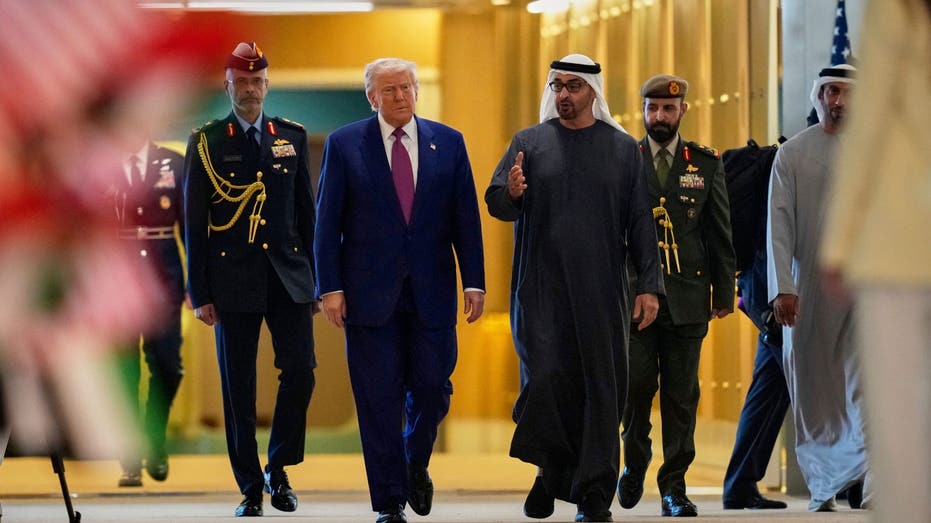
United Arab Emirates President Sheikh Mohammed bin Zayed Al Nahyan greets President Donald Trump at Abu Dhabi International Airport on Thursday, May 15, 2025.(AP Photo/Altaf Qadri)
Preparing for another confrontation
The UAE has already paid a significant price for its proximity to the conflict.
More than 3,000 Iranian missiles and drones targeted the Emirates during the war, according to figures cited by The Associated Press on Nov. 2. The attacks caused casualties and damage to civilian infrastructure.Although no new Iranian attacks had targeted the UAE since May, the threat of renewed confrontation has kept the country on alert.
Al Nuaimi emphasized that while the UAE considers itself a nation committed to peace, it will not hesitate to protect its population.
"Every nation, when it is attacked, [has] the right to defend their people, their sovereignty, their nation," he said.
But he also drew a clear distinction between the Iranian regime and the Iranian people, who are repressed by the regime. "The Iranian people deserve to be respected, accepted. They have great values, great civilization, and they are our neighbor."
A man walks past a housing compound as a tall plume of black smoke ascends following an explosion in the Fujairah industrial zone on March 3, 2026. Iran's strikes on Gulf neighbours since February 28, following the US-Israeli attack, forced the UAE to shut its airspace, blindsiding travellers who thought they were headed to one of the region's safest holiday destinations.(Fadel SENNA / AFP via Getty Images)
A partnership beyond any administration
Despite the confrontation with Iran, Al Nuaimi rejected the suggestion that the UAE's relationship with Washington should be judged primarily through the current conflict or any particular U.S. administration.
"We don't see our relationship with the United States through these conflicts, through security and defense. No, it's a partnership. It's a strategic partnership. It is a sustainable partnership. … Our main partnership is with the United States as a nation, with the American people."
He emphasized that the relationship extends across education, medicine, technology, energy and investment, and is intended to endure political changes in Washington.
"We don't look at the United States through a certain administration. Our engagement and partnership with the United States ... [is] with the nation. It's with the people. ... We have the flexibility and the ability to [adapt] and engage with any administration."
The comments come at a sensitive time for Gulf governments, whose security relationships with Washington have become more consequential as Iran threatens regional infrastructure and international shipping.
At ADIPEC's opening ceremony on Nov. 2, Dr. Sultan Al Jaber, the UAE's minister of industry and advanced technology and chief executive of state-owned energy giant ADNOC, emphasized that the country's ability to withstand the crisis was the result of years of preparation. "We did not write our resilience playbook during this disruption. We wrote it years before," Al Jaber told the audience.
The message was consistent with what officials and analysts repeatedly emphasized during Fox News Digital's visit: the UAE intends to remain a reliable international partner despite the possibility of another regional escalation.
The exhibition floor at ADIPEC 2026 in Abu Dhabi, United Arab Emirates, where global energy companies showcased new technologies and innovations amid growing concerns over energy security and regional instability.(Efrat Lachter/Fox News Digital)
Security beyond military defense
In a separate exclusive interview with Fox News Digital in Dubai, Mohammed Baharoon, director general of the Emirati research center B'huth, argued that the confrontation with Iran has fundamentally expanded the meaning of national security.
"Our resilience now becomes our deterrence," Baharoon said.
The UAE's security strategy, he explained, involves far more than intercepting missiles and drones. It also means ensuring reliable energy supplies, food security, functioning infrastructure and the ability to maintain international commerce during a crisis.
He described three interconnected wars: the initial American-Israeli campaign against Iran, Tehran's subsequent attacks on Gulf states and Iran's disruption of international shipping through the Strait of Hormuz.
"The second war was Iran's attack on the GCC, because that attack was also unprovoked," Baharoon said, referring to the Gulf Cooperation Council.
He described the disruption of shipping as a separate confrontation with the global economy, arguing that the consequences extend to countries far removed from the Middle East.
Despite his criticism of Tehran, Baharoon rejected the idea that Iran should permanently be treated as an enemy. Its population, economic potential and geographical importance, he argued, could make it an important contributor to regional prosperity if its leadership shifted away from confrontation.
Attendees gather at ADIPEC 2026, one of the world's largest energy conferences, held in Abu Dhabi, United Arab Emirates, Nov. 2–5, 2026, as industry leaders discuss global energy security, technological innovation and the growing role of artificial intelligence.(Efrat Lachter/Fox News Digital)
For the UAE, the challenge now is to prepare for the possibility of another confrontation without abandoning the diplomatic and economic relationships it has spent decades building. The crowded streets of Dubai and busy exhibition halls of Abu Dhabi reflect a country determined to move forward, even as the threat of war remains close. Whether the latest negotiations with Iran lead to a breakthrough or another round of fighting, the Emirates is betting that its resilience will allow it to weather the next crisis without losing sight of the future it is trying to build.
Efrat (Effie) Lachter is a reporter for Fox News Digital with more than 15 years of experience covering conflict, global affairs, human rights and political accountability. She has directed and produced more than 200 documentary segments across more than 40 countries, documenting conflicts, humanitarian crises, corruption, human trafficking, gender-based violence and the human stories behind major world events.
Lachter’s reporting has taken her into conflict zones and crisis areas across the Middle East, Europe, Asia and Africa. Her work has included uncovering human trafficking networks, revealing an ISIS underground torture prison in Syria, documenting the war in Ukraine and interviewing senior political figures and world leaders. She was also among the Western journalists who entered Russia after the war began to bring testimonies from Putin’s opposition. Lachter is the recipient of the 2022 Peres Center for Peace Award and was a 2023–2024 Knight-Wallace Journalism Fellow at the University of Michigan. She also won two Rockower Awards for Excellence in Reporting. She holds a bachelor's degree in communication and a master's degree in political science.
Source: Read original story

Comments ()