
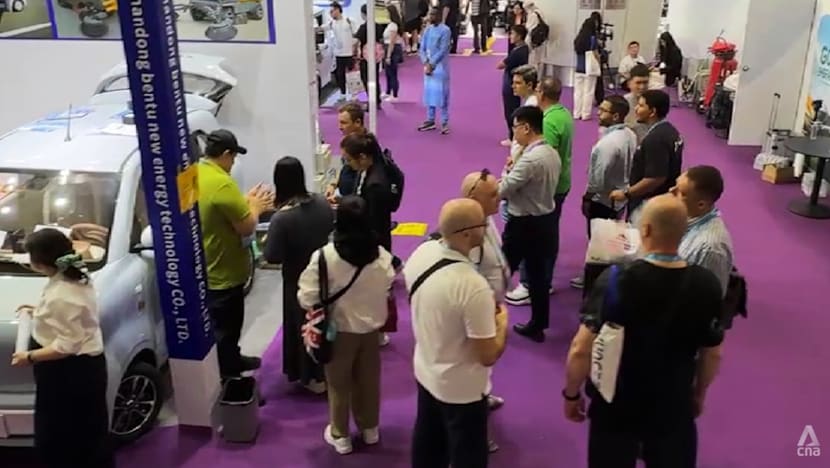
More than 32,000 companies are exhibiting this year, with around 30 per cent focused on high-tech or specialised sectors.
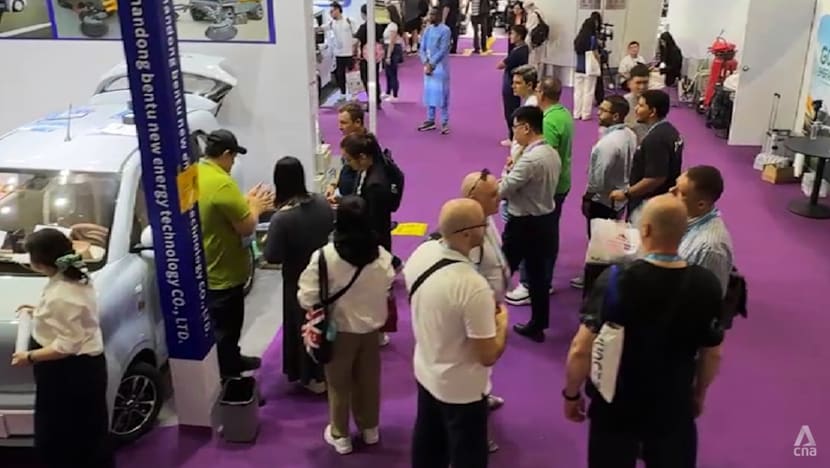
Visitors at Canton Fair, China’s largest and longest-running trade show, in in Guangzhou.
New: You can now listen to articles. 
This audio is generated by an AI tool.

20 Apr 2026 08:38PM
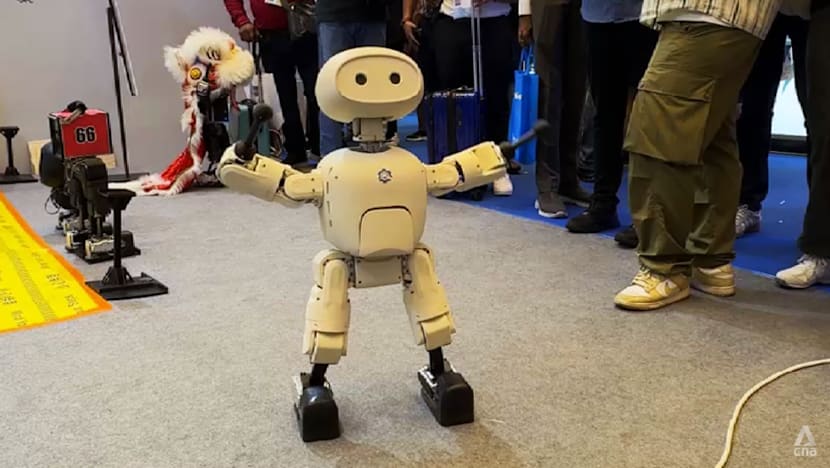
GUANGZHOU, Guangdong: Robots here, there and everywhere.
At the biannual Canton Fair in Guangzhou, China’s largest and longest-running trade show is showcasing a decisive shift towards high-tech innovation – a far cry from its past image as a hub for low-cost goods.
More than 32,000 companies are exhibiting this year, with around 30 per cent focused on high-tech or specialised sectors.
Homegrown products on display range from robotics and artificial intelligence to renewable energy solutions, reflecting Beijing’s push to drive its next phase of growth through innovation.
Buyers from across the globe are taking note of the transformation.
“China nowadays is producing all the technology,” said Akio Kodama, a buyer from Chile who is exploring the use of drones in agriculture, construction and connectivity.
Umar Gafurov, a buyer from Uzbekistan, said he is particularly interested in AI-powered teaching tools.
“AI can help teach the young to learn languages like English and Chinese. The younger generations want to improve, they want to know more about what’s happening in the world,” he told CNA.
Across the exhibition halls, foreign traders – many attending for the first time – are lining up to try out the latest innovations. They say accessibility and relatively low cost of such technologies are a major draw.
STRONG INTEREST
Despite the buzz, questions remain over whether strong interest can translate into sustained sales and long-term investment. Some companies say competitive pricing is already paying off.
Tianjin-based Deepinfar Ocean Technology, for instance, said customers are placing on-the-spot orders at the fair for its underwater scooters used in swimming and diving.
The company also produces more advanced underwater robots capable of reaching depths of up to 3,000m, used for inspecting subsea cables, supporting search-and-rescue missions and monitoring water quality.
The firm’s marketing manager Zhang Mingyu said its products are developed and produced locally.
“China has prioritised deep-sea science and tech in recent years, which encouraged us to develop the technology. There are certainly some challenges, but we constantly improve our tech and competitiveness to deal with them,” she said.
SHIFTING STRATEGY
The shift towards higher-value products reflects a broader transformation in China’s export sector.
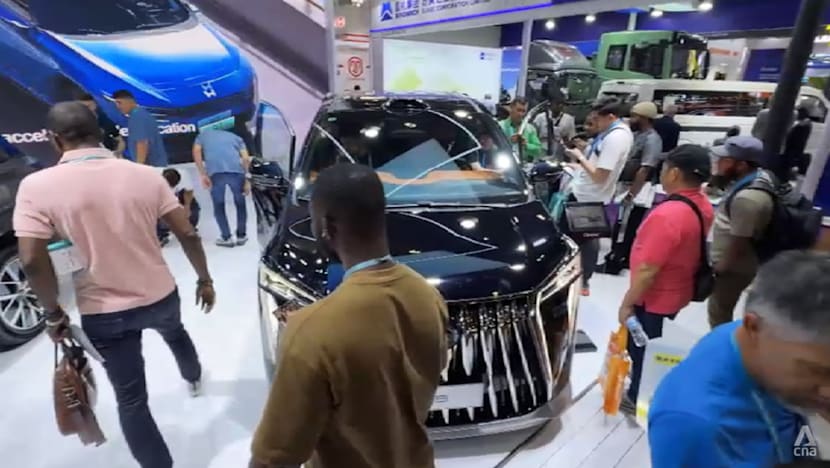
However, intense price competition continues to squeeze margins, prompting some firms – particularly those in the electric vehicle industry – to rethink their strategies.
Chengdu Zhongxinhai Industrial Group, for example, initially focused on rapid global expansion when it first ventured into the EV business.
“But now that we’ve grown, we’ve realised the need to maintain long-term relationships. We’re prioritising safety and stability, before we gradually look for (other) opportunities,” said Alisa Yang, an executive director at the firm.
External pressures are also building. Rising raw material costs and trade uncertainty, partly linked to the ongoing Iran war, are weighing on businesses.
Analysts say these dynamics are reshaping demand at the Canton Fair, with growing interest in higher-end technology even as buyers remain price-sensitive.
“The Iran war has accelerated this upmarket shift,” said Liao Minxiong, a senior analyst at consultancy firm TS Lombard APAC.
“It raises the opportunity cost of long-haul travel for low-margin sourcing, and increases the rewards of showing up to source (higher-value) products.”
At the same time, soaring energy prices are boosting demand for renewable solutions.
“AI-powered factory automation and smart manufacturing offerings directly reduce buyers’ production cost – a strong sell when margins are squeezed by the Iran war energy shock,” said Li Jiahao, an associate researcher at the Guangzhou Institute of Greater Bay Area.
“The war also underscores how deliberately Beijing has prepared for an era of energy geopolitics. So, the narrative is resonating with investors who focus on long-term structural trends.”
Some firms at the fair report that enquiries and sales for solar panels, inverters and wind turbines have risen by as much as 50 per cent since the latest Iran conflict began.
For buyers like Sachin Inamdar, who travelled from India, the appeal is clear: “Getting to see (so many) new technologies in one place is worth the visit.”
He added that he is exploring alternative energy solutions amid growing demand back home amid a global shift away from fossil fuels.
INNOVATION NOT A SILVER BULLET
Still, analysts caution that innovation alone may not be enough to sustain China’s growth.
The country placed tech as a key strategic pillar in its 15th Five Year Plan.
“The Iran war hits global purchasing power indiscriminately, even buyers of chips and services face rising operating costs,” said Li. “The honest assessment is that tech buys China resilience, but not immunity.”
That makes China’s “dual circulation” strategy of boosting domestic consumption while expanding trade with non-Western markets increasingly important, he added.
This comes as national security concerns remain an impeding factor, with China still facing tech export restrictions from the United States.
The European Union also recently stopped funding clean projects containing Chinese inverters.
“The bigger story is that China’s export mix is shifting up the value chain, as you might be seeing in EVs, solar, servers and batteries,” said Liao.
“These are replacing labour cost intensive industries like those producing T-shirts and toys. That tech push can insulate the top line but doesn’t really protect the millions of small- and medium-sized enterprises at non-tech industries.”
China’s exports grew 14.7 per cent in the first quarter, but momentum slowed to a five-month low in March – a sign that challenges may lie ahead.
The Canton Fair runs until May 5, with final sales figures expected to offer a key gauge of the health of China’s export engine.