
China and the US have a vested interest in supporting Southeast Asia’s anti-cyberfraud efforts, but cooperation between the two countries is unlikely, says this academic.
SINGAPORE: Cyberfraud and the proliferation of massive online scam centres are growing problems throughout Southeast Asia. Both China and the United States have vested interests in combating such criminal activities. Unfortunately, the pragmatic application of solutions tends to get mired in geopolitical rivalry.
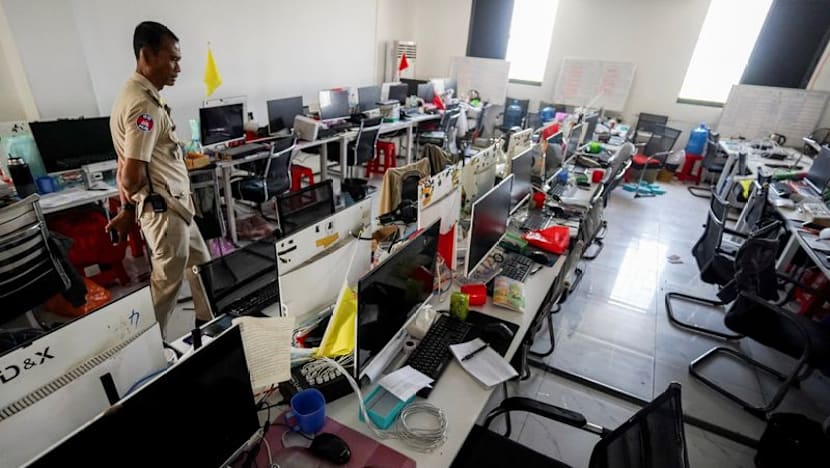
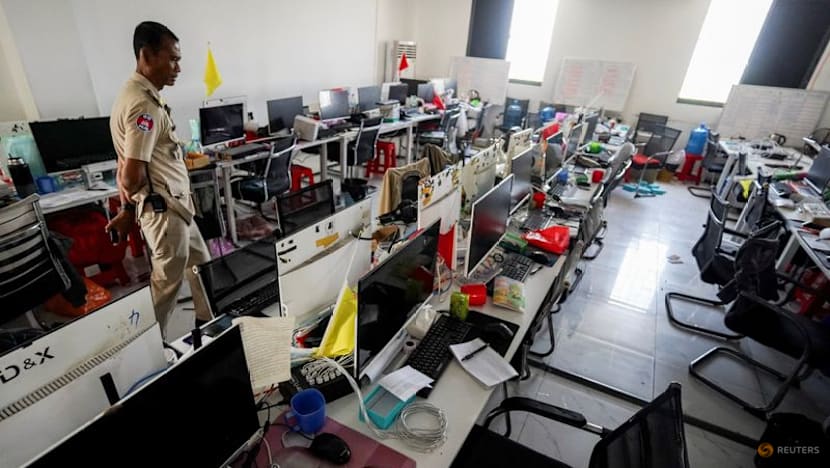
Roughly half a million people have ended up in scam centres across the region through a variety of channels, including fake job offers, forced labour and sometimes willing participation born of economic desperation. In many instances, the people staffing these centres are themselves the victims of human trafficking.
These operations generate tens of billions of dollars in stolen funds annually, with Myanmar, Cambodia and Laos forming the epicentre. These three countries likely accounted for US$43.8 billion in illicit proceeds – an amount equivalent to a staggering 40 per cent of their combined gross domestic product.
The ill-gotten gains are laundered through cryptocurrencies, casinos and regional financial networks, fuelling corruption and providing income streams for criminals and non-state militias.
Given the magnitude of the problem, China and the US have a vested interest in supporting Southeast Asian countries in their battle against cyberfraud. At first glance, it might seem that cyberfraud would be a welcome area of cooperation between the US and China.
Unfortunately, however, the inherently strategic nature of many of the tools needed to fight scam syndicates means that anti-cyberfraud efforts are becoming a new and widening front in US-China rivalry.
JOCKEYING FOR POSITION
Any effort to combat global cybercrime should include issues surrounding data access, surveillance and cross-border policing efforts. It would be difficult, however, to imagine a set of issues where cooperation between the US and China would be less likely.
Predictably, both countries are jockeying for position, trying to ensure that their digital tools, digital standards and security partnerships become the preferred option in Southeast Asia.
China’s approach to the issue prioritises cyber sovereignty and relies on state-controlled surveillance applications, centralised citizen tracking systems and police deployments to neighbouring countries.
The police deployments have certainly produced impressive results. Through joint law enforcement efforts between China and Myanmar, over 57,000 Chinese citizens have been arrested on suspicion of cyberfraud. As with China’s highly effective citizen tracking systems, however, the focus is on identifying Chinese victims and perpetrators.
The US has traditionally stood for open, interoperable systems and relies on private sector encryption safeguards, intelligence sharing, AI-enabled detection and human rights protection.
These aid the fight against scam centres in a number of ways, such as helping to protect personal data that scammers can exploit, alerting consumers to potential scams and making at-risk individuals less vulnerable to human traffickers. The US sees scam centres as part of a global cybercrime and human trafficking problem, with the US leading interdiction efforts.
China, however, has already positioned itself well to play a preeminent role in regional anti-cybercrime operations in Southeast Asia.
China leads the Lancang-Mekong Integrated Law Enforcement and Security Cooperation Center, a joint mechanism that includes Cambodia, Laos, Myanmar, Thailand and Vietnam. It has facilitated joint operations, intelligence sharing, repatriations and targeted raids since 2023, with a new phase launched in 2025.
US ANXIETIES
China’s prominence in these efforts has fuelled a variety of US anxieties. For instance, the US has concerns about China playing a leading police role in cracking down on cybercrime operations. In the course of operations to defraud trusting consumers, scam centres obtain significant personal data on their victims.
Should Chinese law enforcement agencies end up in possession of this data, the US suspects that potentially compromising information on US citizens – that could support espionage efforts – would be passed to the Chinese security apparatus.
From the US perspective, the installation of Chinese surveillance systems in Southeast Asia – even in furtherance of the shared objective of fighting cybercrime – would not be a welcome development. It embeds Chinese technology more firmly in the region and empowers regimes more inclined towards China’s governance model, further expanding China’s regional influence.
For example, Huawei has installed a city-wide surveillance grid in Bangkok. In Laos, Chinese companies have installed Laos’ Ministry of Public Security internet network system to help local police combat cybercrime.
The US is also concerned about China’s tendency to focus enforcement efforts primarily on Chinese victims rather than treating it as a global challenge requiring a global response. In the mind of cynics at least, China seems primarily interested in protecting Chinese citizens rather than eradicating the global industry.
This reflects China’s view of the problem primarily as a source of potential political instability. Chinese citizens have been frequent targets of online fraud. China’s police have reported detecting US$45.2 billion in attempted online scams directed at Chinese citizens, but the actual figure is thought to be much higher as a result of non-reported frauds due to embarrassment or other reasons.
RISING POLICY PRIORITY FOR BEIJING
As a growing number of Chinese citizens lose some or all of their life savings to cybercrime, the prospect of civil unrest fuelled by dissatisfaction over governmental impotence will grow. Understandably, combatting cybercrime has become a rising policy priority for China’s Communist Party. But China’s focus is not on foreign victims.
This is problematic from the US perspective for obvious reasons. To the extent that criminal networks perceive that it is no longer prudent to victimise Chinese citizens, American citizens will find themselves increasingly targeted.
Cyberfraud is a growing economic and social problem in Southeast Asia as well as a new source of competition for the US and China. For their part, most countries in Southeast Asia would appreciate some form of assistance in fighting the scourge of scam centres without compromising their autonomy or getting dragged into the wider Sino-US geopolitical rivalry.
Unfortunately, given the heavy strategic overtones of many of the tools required to combat cyberfraud, this issue is growing more deeply intertwined in the US-China contest for regional influence.
For the countries of Southeast Asia, the best course is to pragmatically tap into the most useful assistance available from either country, while attempting to avoid alienating one side or the other. This is a difficult tightrope to walk, but one which countries in the region have demonstrated an aptitude for over the years.
The unfortunate result of this balancing act, however, will be a more fragmented and less cohesive approach to combatting cyber-crime networks. Ultimately, the real winner could end up being the malefactors who operate scam centres and prey on human misery.
Stephen Olson is a Visiting Senior Fellow at ISEAS – Yusof Ishak Institute and a Non-Resident Fellow and Visiting Lecturer at the Yeutter Institute of International Trade. This commentary first appeared on ISEAS – Yusof Ishak Institute’s site, Fulcrum.