
analysis Asia
Former economy minister Rafizi Ramli’s persistent attacks on the government and his party are likely to damage Parti Keadilan Rakyat’s standing ahead of national and state polls, but sacking him may not be an option, analysts say.
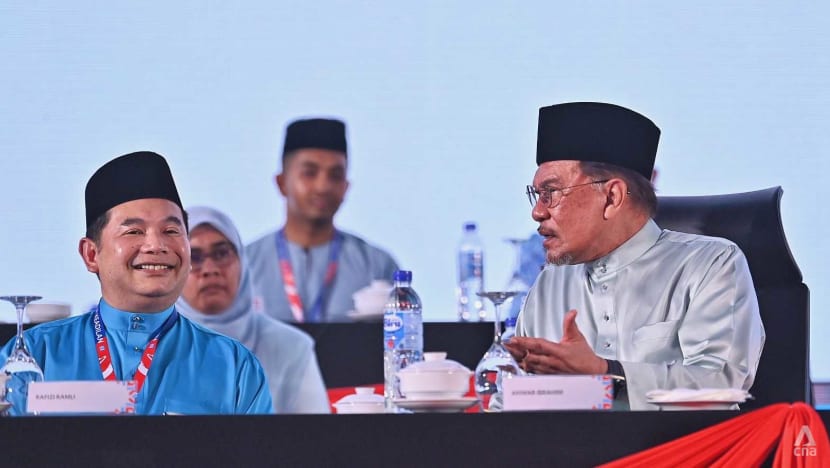
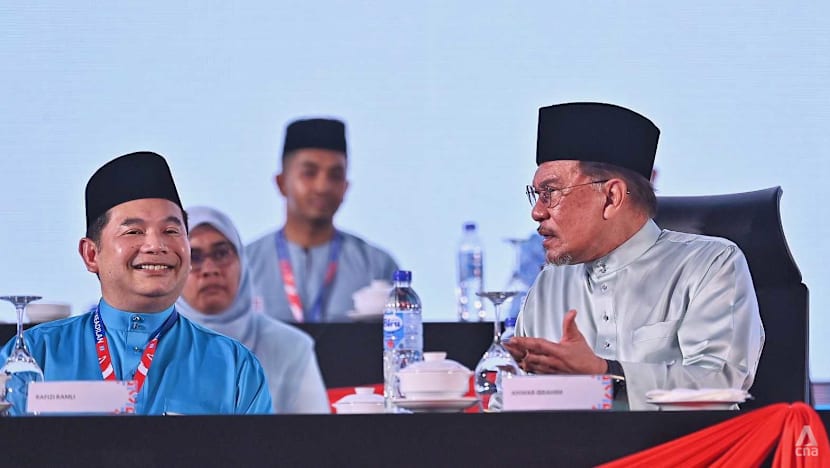
Parti Keadilan Rakyat (PKR) president Anwar Ibrahim (right) speaks to then-deputy president Rafizi Ramli during the 18th PKR National Congress on May 23, 2025. (Photo: CNA/Zamzahuri Abas)
New: You can now listen to articles. 
This audio is generated by an AI tool.

21 Apr 2026 06:29PM (Updated: 21 Apr 2026 07:00PM)
KUALA LUMPUR: Every Friday night, thousands of Malaysians tune in to “Yang Berhenti Menteri” (“The Minister Who Quit”), a podcast hosted by former economy minister Rafizi Ramli.
The episodes, which can stretch beyond three hours each, regularly rack up hundreds of thousands of views as Rafizi dissects the Madani administration.
On the podcast, which he began in June last year after resigning from the Cabinet, Rafizi has pulled no punches when it comes his Parti Keadilan Rakyat (PKR), headed by Prime Minister Anwar Ibrahim.
Among other things, Rafizi has accused Anwar of surrounding himself with “yes-men”, protecting vested interests, and failing to deliver on the reforms that once defined PKR, which is part of the ruling Pakatan Harapan (PH) coalition.
Anwar himself has sidestepped Rafizi’s criticism and called it an internal party matter while some PKR grassroots leaders have called for action to be taken against Rafizi.
The most high-profile rebuke against Rafizi has come from Human Resources Minister and party vice president R Ramanan, who labelled Rafizi a “failed minister” and accused him of acting with an “unhealthy agenda to divide the party”.
Even as he has become one of the government’s most vocal critics, Rafizi remains in PKR and a Member of Parliament for Pandan constituency, still commanding the support of a sizable group of the party’s MPs.
But his persistent criticism of the government has caused tension and severe discomfort among the PKR rank and file, party insiders told CNA.
With national and state polls possibly held as early as this year, analysts said the internal stand-off poses a challenge to PKR and raises the stakes for both sides.
This month, Rafizi dared the party to sack him after he received his second show-cause letter on Apr 9 from its disciplinary board outlining four key allegations against him.
Rafizi was accused of:
- tarnishing PKR’s reputation by attacking Anwar’s leadership style as encouraging a “brown-nosing” culture,
- alleging that Anwar protected vested interests and “corporate mafias”,
- claiming that Anwar allegedly enabled defamation against him, and
- accusing Anwar of defending Malaysian Anti-Corruption Commission (MACC) chief Azam Baki, who is implicated in a shareholding controversy.
Posting a four-page rebuttal on Facebook the next day, Rafizi said he hoped the disciplinary board would make a “firm and swift decision” without further delay, as the public was already fed up with the matter.
“If my explanation is deemed to have violated the party constitution, then act like a normal (rather than a dysfunctional) party and take the step of sacking me — just as has been done to other members facing disciplinary charges before,” wrote Rafizi, 48, who stepped down as economy minister after losing the PKR deputy presidency to Anwar’s daughter Nurul Izzah Anwar in a party election last May.
Analysts told CNA that by challenging the party to fire him, Rafizi is trying to force PKR and Anwar into making a decision.
Rafizi’s tactic can be interpreted as a calculated move to challenge the party leadership, effectively inviting Anwar and the party to remove him in a manner that preserves his political dignity rather than exiting voluntarily, said Hisommudin Bakar, executive director of research firm Ilham Centre.
“This is closely linked to existing internal party understandings and legal precedents, where elected representatives are bound by anti-defection commitments that include financial penalties,” he said.
“By forcing the leadership into a decision, Rafizi indirectly tests Anwar’s moral authority, as any action taken or avoided will be scrutinised as a reflection of leadership consistency, internal democracy, and political control within PKR,” he added.
PKR UNLIKELY TO SACK RAFIZI
Analysts believe PKR is unlikely to take severe disciplinary action against Rafizi in the immediate term.
This is because the party is likely wary of legal loopholes that could allow him to remain an MP, said Syaza Shukri, a political scientist at the International Islamic University Malaysia (IIUM).
If Rafizi quits PKR, he would need to vacate his seat but if the party sacks him, he may remain as an MP, based on what happened to opposition party Parti Pribumi Bersatu Malaysia’s (Bersatu) members, she noted.
Under Malaysia’s Anti-Hopping Law, MPs must vacate their seats if they resign from their party or join another party.
After six Bersatu MPs switched allegiance to the government in 2023, they were sacked by the party.
However, Dewan Rakyat Speaker Johari Abdul ruled in July 2024 that the MPs were not required to vacate their seats. He said the anti-hopping law was not triggered, because the members were expelled and did not resign of their own accord.
Syaza did not believe that Rafizi having aligned MPs to him would significantly factor into the party’s considerations regarding how it handles the situation.
“They can just kick Rafizi out and leave the rest to figure out what they want to do.
“They’re not going to leave now due to the anti-hopping law. Maybe it complicates the long term survival of the party. But even if the party doesn’t do anything now, I think the writing is on the wall that they will follow Rafizi for GE16,” she said, referring to Malaysia’s 16th General Election due by February 2028.
In Hisommudin’s view, PKR’s leadership appears inclined to maintain strategic restraint by allowing the situation with Rafizi to remain unresolved, rather than escalate it with an expulsion.
“This approach suggests a preference to avoid internal fragmentation while managing the political optics of dissent within the party,” he said.
A PKR division head also told CNA the party would leave the situation as it is.
“If the party sacks Rafizi, people will accuse it of curtailing the right of members to speak,” said the division head, who spoke on the condition of anonymity.
The division head also believed Rafizi had been positioning himself to be the future president of the party.
“In my personal opinion, everyone in politics wants power and Rafizi was upset at being taken out. If you are a president of a political party, you have a lot of power especially when you go into a general election,” added the division head.
The division head pointed out that Rafizi is PKR’s former strategist and still commands support among a number of PKR’s 31 parliamentarians.
Those seen to be aligned with Rafizi include Setiawangsa MP and former environment minister Nik Nazmi Nik Ahmad, Subang MP Wong Chen, Petaling Jaya MP Lee Chean Chung, Ampang MP Rodziah Ismail, Wangsa Maju MP Zahir Hassan, Sungai Siput MP S. Kesavan, Balik Pulau MP Bakhtiar Wan Chik, Pasir Gudang MP Hassan Karim, and Batu Pahat MP Onn Abu Bakar.
Rafizi and the nine MPs had signalled their collective stance by signing a joint statement on Apr 20, objecting to a reported plan by the government to adopt a new migrant worker management system.
The group has also held joint press conferences to challenge policy directions they deem inconsistent with reform.
CNA has reached out to PKR and an aide of Rafizi for comments.
WHAT IS THE IMPACT ON PKR?
The simmering tensions will have an impact on PKR, said analysts and party insiders.
The PKR division head acknowledged that while some of Rafizi’s policy critiques are valid, his methods are destructive and damage the party’s credibility, tarnishing its public image.
“Of course there is an impact on the party. The only question is how big or small the impact is,” he said, adding that there are better ways of voicing criticism.
In his podcasts, Rafizi has not held back, targeting figures like Anwar’s former aide Farhash Wafa Salvador and Ramanan.
Among other things, Rafizi has alleged Farhash’s business dealings could have a political impact on the government. He has questioned why Ramanan was given “special treatment” that allowed him to rise quickly through party ranks.
According to Hisommudin, the issues Rafizi has raised have consistently gained traction in the media, and this has been amplified when circulated across digital platforms.
“His disclosures, particularly those that subtly reveal internal decision-making processes involving Anwar and the Cabinet, pose a significant challenge to both leadership credibility and party cohesion,” he said.
Rafizi’s barbed comments about Anwar include one in February, where he said Anwar’s sole preoccupation in life was to become prime minister.
Earlier this month, Rafizi claimed that prior to the 15th General Election in November 2022, Anwar had “begged with tears in his eyes” for Rafizi to drop his opposition to Ramanan being fielded as a candidate.
Rafizi claimed in his podcast that he agreed to Ramanan’s candidacy only on the condition that Ramanan would never be appointed to a senior leadership role in the party, or a position in the government if they won.
These criticisms have seriously dented the PH government’s reformist credentials, said James Chin, a professor of Asian studies at the University of Tasmania.
“The overall message (from Rafizi) is that no reforms are possible under Anwar. This situation is entirely self-inflicted; a deal should have been negotiated much earlier,” he said.
Hisomuddin agreed it may be strategically clearer for PKR to formally sever ties by sacking Rafizi instead of prolonging the ambiguity.
The fallout has led voters to question the prime minister’s core principles, and the indecision regarding Rafizi’s membership is confusing, added Syaza.
“If what Rafizi did is so bad, then why wouldn’t PKR sack him, even if that means losing a seat? Is principle not important to Anwar?” she explained.
“People are going to question cohesion within the party and it’s going to affect trust towards the party’s credibility and also Anwar. It’s not going to help the party’s prospects in the next election,” she said.
Malaysia’s GE16 must be called by February 2028, although several states face earlier deadlines.
The current Melaka state government’s term ends in December 2026, while the current Johor state government’s term ends in April 2027. This means their state elections are due by February 2027 and June 2027, respectively.
Sarawak, meanwhile, must hold its state election by April 2027.
WHAT NEXT FOR RAFIZI?
Rafizi has set a deadline for his political future, saying in February that he plans to reveal his next chapter in June, exactly a year after his resignation took effect on Jun 17, 2025.
Analysts said Rafizi will likely announce a new political platform or party.
“From a strategic standpoint, such a move would allow him to formalise his political positioning outside PKR while maintaining continuity with his existing narrative,” Hisomuddin said.
Rafizi’s recent grassroots engagement in Pandan constituency appears significantly stronger than previously, Hisomuddin observed.
Rafizi, along with other Members of Parliament aligned with him, would likely position themselves as a competitive alternative to Pakatan Harapan in the next GE, he said.
Given Rafizi’s strong command of digital media and the extensive coverage he continues to receive, he could become an independent or alternative candidate, appealing to voters dissatisfied with PH, Hisomuddin added.

Syaza said Rafizi could start a new party, but whether it will hold enough appeal to voters remains to be seen.
“I think Rafizi and friends can realistically build a small urban-based party for (left-leaning) people who are frustrated with PKR/PH. But does Rafizi have enough pull based on his personal brand?” she questioned.
“If he wants to portray himself as a martyr or like Anwar 2.0, unfortunately I don’t see Rafizi as that charismatic leader. He is too (much of a) pragmatist to be the kind of politician Anwar is that could get massive support,” she said.
A PKR insider had similar doubts about Rafizi’s place in the political landscape and which parties he could potentially form an alliance with, should he leave PKR.
The insider noted that in the last general election, former stalwarts such as ex-deputy president Azmin Ali and former vice-president Tian Chua both suffered defeats after leaving the party fold.
He also cited a no-confidence motion brought against Rafizi during the Pandan PKR annual general meeting in early April.
Rafizi narrowly survived after 42 division members voted against his removal as division chief — a slim eight-vote margin over the 34 who favoured his dismissal or suspension.
“Rafizi had his followers, but not all of that support was as genuine as it seemed, as many were simply betting on him as the next president,” said the insider.
“PKR has a history of factions and splintering; we’ve seen this kind of thing happen in waves before.”