
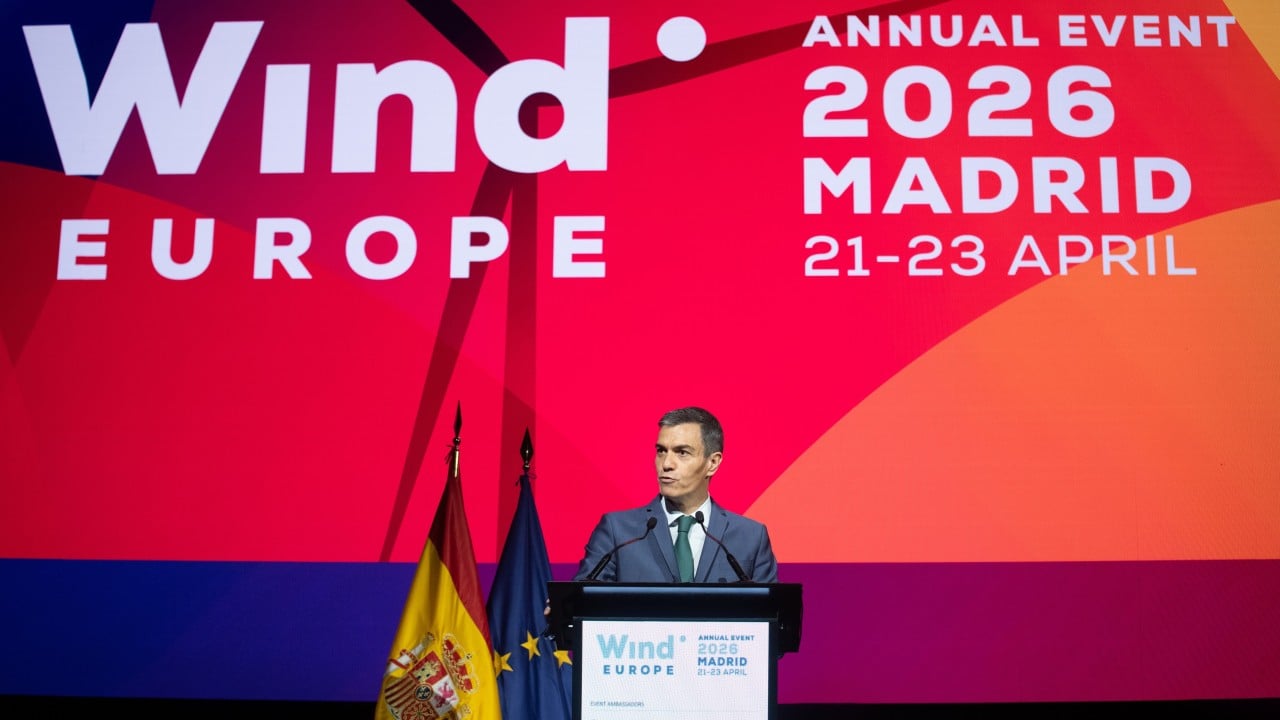
The wind industry smells opportunity in Europe. At an expo in Madrid this week, the convention floor was abuzz as hundreds of European, American, Japanese and Korean exhibitors vied to pitch their products, knowing the continent urgently needs to shore up its energy security amid the US-Israel war on Iran.
But there was one glaring absence: not a single company operating a booth was Chinese, with China’s participants only networking from the sidelines. At a time when many in Europe seek a rapid build-up of wind capacity, the peripheral role being played by
the world’s dominant supplier felt all the more striking.
The question of how China should participate in Europe’s wind power drive reared up again and again in Madrid – from panel discussions to huddles in the hallways. For many, the answer will hinge on how policymakers reconcile two competing priorities: localising production versus managing costs.
“It’s a tightrope, and it’s not only with respect to China, but of course China has a very specific place in this entire discussion,” said Pierre Tardieu, chief policy officer of WindEurope, the wind industry association that organised the gathering.
For Tardieu, putting the emphasis on “made in Europe” is politically attractive, because it generates local jobs and builds public support. But it also drives up costs, and if the final product becomes too expensive, the market will not adopt it – undermining the green transition itself.
“Talking about diversification and resilience … there is some kind of market recognition required for it and that is really the biggest challenge,” said Heiko Juritz, chief operating officer of Enercon, one of Europe’s leading wind turbine manufacturers.
There are also areas of the supply chain where Europe’s own capacity constraints could become a bottleneck for the expanding sector, with steel being a good example, according to Juritz.
“If you are over-regulating the supply market with tariffs, with other regulations for imports … then we are running into costs, and we are running into constraints on supply,” he said. “Both will definitely be unhealthy for our competitiveness.”